 AI Agents Hub
Voice AI Platforms in 2026: VAPI vs Retell vs ElevenLabs
Three voice AI infrastructure providers have taken different paths in 2026: VAPI gives developers full control, Retell owns the phone call use case, and ElevenLabs sets the voice quality standard. Here's how to pick.
If you want to add a voice interface to an AI agent, a phone answering service, or a customer support workflow, three infrastructure providers have separated from the pack in 2026. VAPI is the developer-first voice AI platform that gives you full control over the LLM, voice model, and call flow. Retell is the hosted voice AI optimized for phone calls — natural, latency-minimized, and purpose-built for inbound/outbound call centers. ElevenLabs is the AI voice synthesis powerhouse — the best text-to-speech quality in the industry, now adding real-time voice-to-voice conversation to its lineup.
Each does one job exceptionally well. None of them is a complete solution on its own — you almost always combine a voice synthesis tool with a voice AI platform to get a full pipeline. This post compares the three head-to-head using the profiles in our 62-agent directory, then tells you which to use for which job.
The voice AI stack: how these tools compose
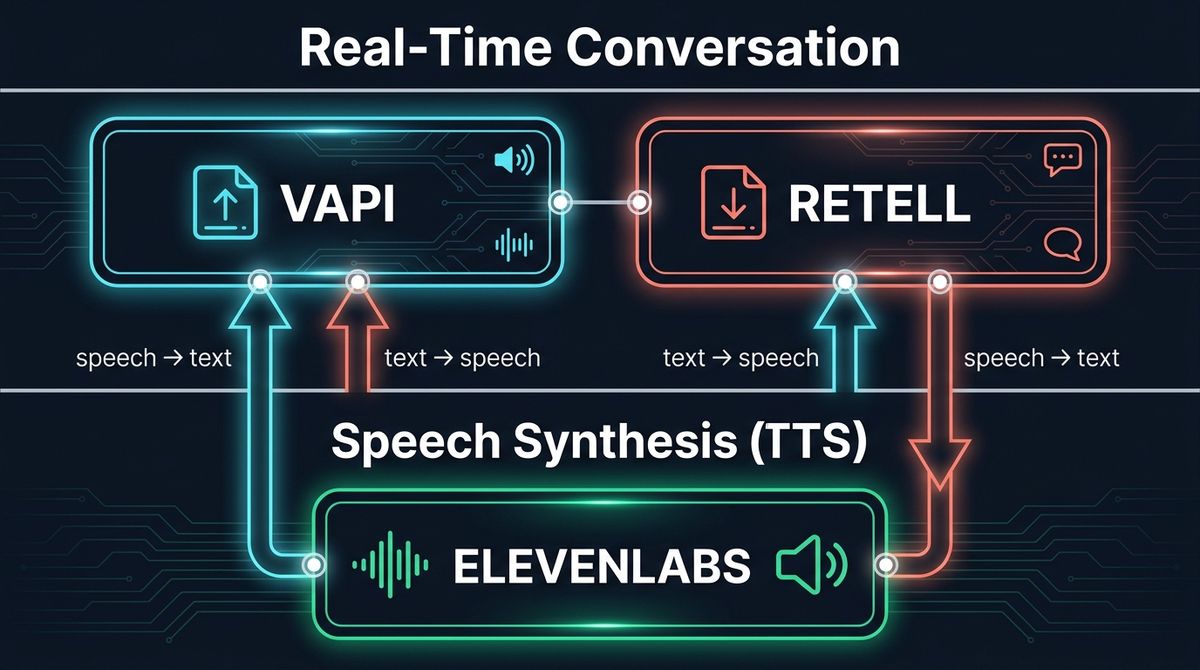
Before comparing, it helps to understand the two layers in any voice AI system. The first layer is speech synthesis — converting text to a natural-sounding voice. The second layer is real-time conversation — hearing what a human says, transcribing it, routing it to an LLM, getting a response, and speaking it back with minimal latency.
ElevenLabs dominates layer one. VAPI and Retell are both trying to own layer two — and they take different approaches to it.
VAPI: the developer-first voice AI platform
VAPI is the open-source voice AI infrastructure platform that gives you full control. It handles the entire call pipeline — WebRTC connection, speech-to-text, LLM routing, text-to-speech — and exposes each layer as a configuration option. You can swap in any LLM (OpenAI, Anthropic, Groq, etc.), any voice provider (ElevenLabs, Cartesia, Deepgram, etc.), and any use case (outbound sales, inbound support, AI companion, scheduling assistant).
The pitch is control and flexibility. If you want to build a voice AI that speaks with a specific personality, handles specific domains, and integrates with your existing backend, VAPI gives you the primitives without opinionating about the details. The open-source server means you can self-host if you need data residency or cost control, and the managed cloud tier means you can go live without infrastructure work.
Where VAPI is weak: the voice quality depends entirely on which voice provider you wire in. The default voices are functional but not best-in-class. For production outbound sales or phone support, you will want to pair VAPI with ElevenLabs voices — which means two subscriptions and more configuration complexity. The other soft spot is latency: VAPI's default configuration has a perceptible lag between human speech end and AI response start, which matters for natural conversation.
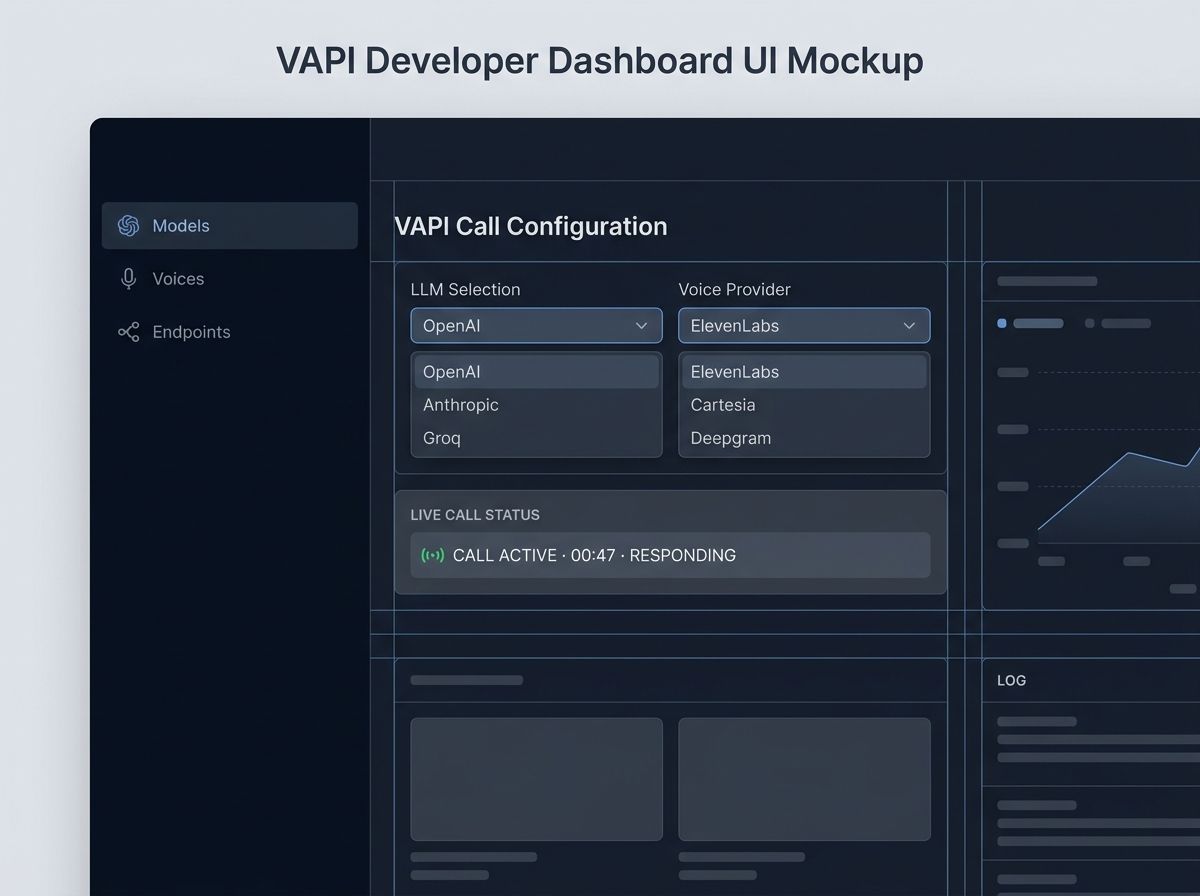
Pick VAPI if you are a developer building a custom voice AI application and you want full control over the model, voice, and conversation logic. Skip it if you want a turnkey phone solution with best-in-class voice quality out of the box — Retell or ElevenLabs are better starting points.
Retell: the phone-native voice AI
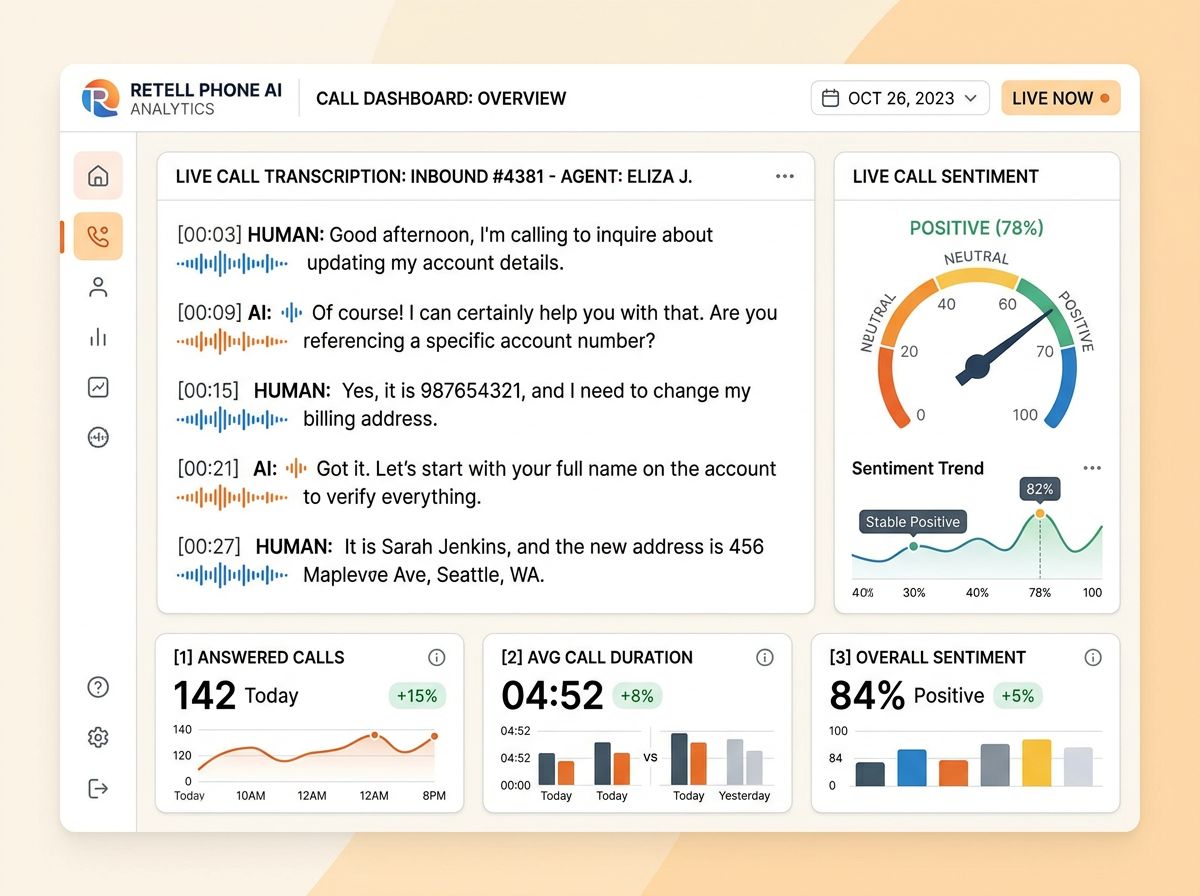
Retell is the hosted voice AI platform purpose-built for phone calls. It optimizes every layer for the specific constraints of a telephone conversation: ultra-low latency (humans expect phone AI to respond in under 300ms), natural voice quality that passes the "is this a robot?" test, and turnkey integration with phone carriers (Twilio, Telnyx, Aircall) and CRMs (Salesforce, HubSpot).
The pitch is "production phone AI, end-to-end." You configure a voice agent (pick a voice, wire in an LLM, define the call flow), connect it to a phone number, and it handles inbound/outbound calls. Retell's own voice models are specifically tuned for phone conversations — they handle interruptions, overlapping speech, and the acoustic variability of phone lines better than generic TTS engines.
The standout feature is the sub-300ms end-of-speech detection. In a phone call, latency is felt as awkwardness — a 1-second pause between a human finishing speaking and the AI starting to respond feels like a bad phone connection, not an AI. Retell's EOS detection minimizes this, making the conversations feel genuinely natural.
Where Retell is weak: it is opinionated in ways that VAPI is not. You pick from Retell's voice library, you use Retell's call flow configuration, you integrate via Retell's API. If you want to use your own voice synthesis or custom call logic, VAPI is more flexible. The other soft spot is pricing — Retell's managed platform has per-minute pricing that can add up for high-volume call centers, and self-hosting is not an option.
Pick Retell if you need a production voice AI for phone calls — inbound support, outbound sales, appointment scheduling — and you want it live in days, not weeks. Skip it if you need full customization of the voice, model, or call logic, or you are building a non-phone voice application (web, app, in-person kiosk).
ElevenLabs: the voice synthesis powerhouse
ElevenLabs is the industry-leading AI voice synthesis platform. Its text-to-speech quality is the closest thing to a professional voice actor that exists in software — the intonation, the pacing, the emotional range, and the naturalness are all best-in-class. If voice quality is the primary requirement, ElevenLabs is the right answer almost every time.
In 2026, ElevenLabs has extended beyond pure TTS into real-time voice-to-voice conversation. Its Conversational AI product lets you build voice agents that use ElevenLabs voices and models — giving you the best voice quality in the market combined with the ability to handle live conversation. The latency is competitive with VAPI and Retell, and the voice quality is objectively better.
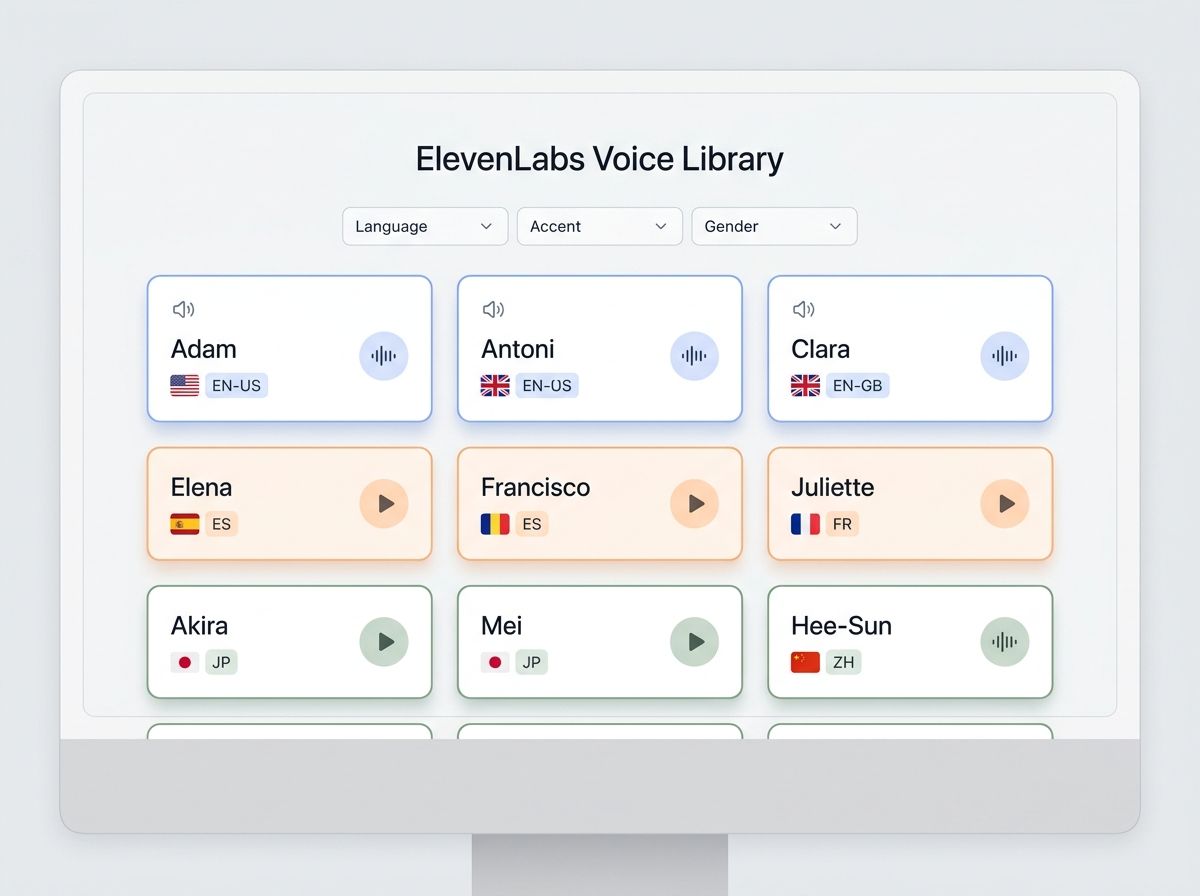
The other under-appreciated capability is the Voice Library — thousands of pre-built voices across languages, accents, and styles. If you need a Spanish-speaking sales agent, a British-accented customer support bot, or a voice that matches your brand's personality, ElevenLabs has more options than anyone else in the market.
Where ElevenLabs is weak: as a standalone voice AI platform, it requires more assembly than VAPI or Retell. You bring your own LLM logic, your own call flow, your own telephony integration. For developers who want full control this is fine; for teams that want a turnkey phone solution, the assembly cost is real. The Conversational AI product is newer and less battle-tested than VAPI or Retell for high-volume production phone workloads.
Pick ElevenLabs if voice quality is your primary requirement and you have developers who can assemble the rest of the stack. Pair it with VAPI for the conversation layer, or use ElevenLabs' own Conversational AI if you want a more integrated experience. Skip it if you want turnkey phone AI without assembly work — Retell is faster to production.
Comparison at a glance
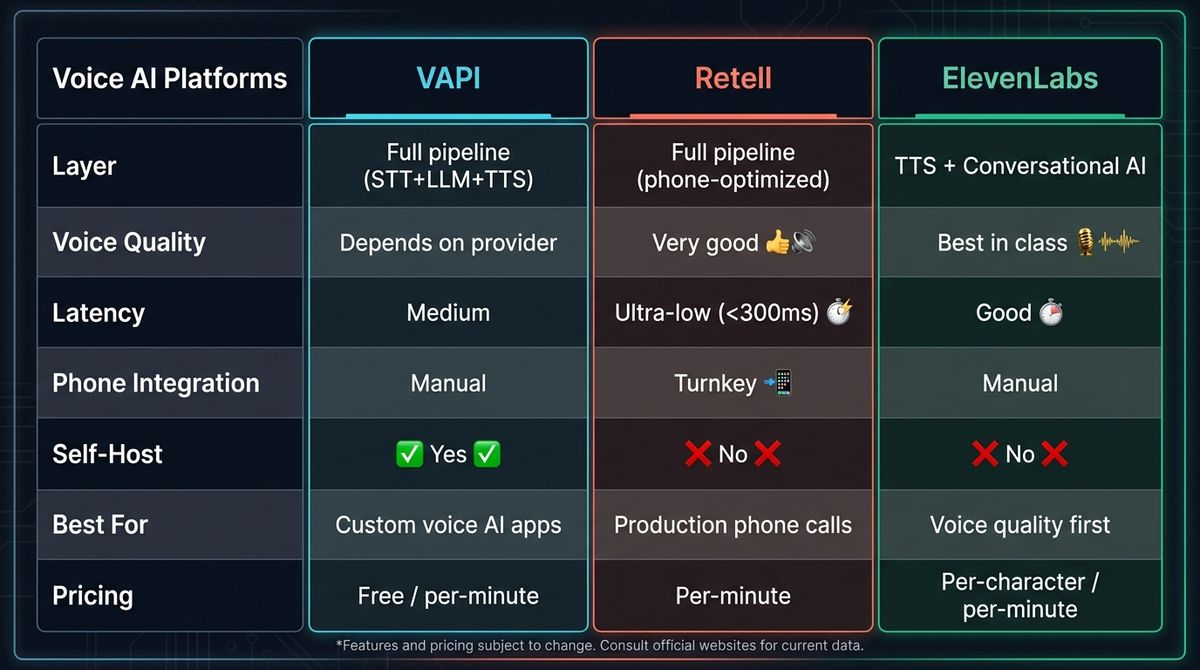
| VAPI | Retell | ElevenLabs | |
|---|---|---|---|
| Layer | Full pipeline (STT + LLM + TTS) | Full pipeline (optimized for phone) | TTS + Conversational AI |
| Voice quality | Depends on voice provider | Very good (phone-optimized) | Best in class (TTS) |
| Latency | Medium (customizable) | Ultra-low (<300ms, phone-tuned) | Good (Conversational AI) |
| Phone integration | Manual (Twilio, etc.) | Turnkey (Twilio, Telnyx, Aircall) | Manual / Conversational AI |
| Self-host option | Yes (open-source server) | No | No |
| Best for | Custom voice AI apps | Production phone calls | Voice quality first |
| Pricing | Per-minute (cloud) / free (self-host) | Per-minute (managed) | Per-character (TTS) / per-minute (Conversational AI) |
Verdict by use case
If you are building a custom voice AI application (web, app, robot, in-person kiosk): VAPI. The full pipeline, the open-source option, and the flexibility to wire in any LLM and any voice provider make it the right foundation for custom builds.
If you need production phone AI in days: Retell. The turnkey phone carrier integration, the ultra-low latency, and the phone-optimized voice quality make it the fastest path from "we need an AI answering our phones" to live. Pair it with ElevenLabs voices if the default voices are not good enough for your brand.
If voice quality is the primary requirement: ElevenLabs. The TTS quality is best-in-class and the Voice Library is unmatched. Build on top of it with VAPI's conversation layer, or use ElevenLabs' own Conversational AI product for a more integrated experience.
For most production voice AI deployments, you end up using two of the three. VAPI + ElevenLabs for custom applications where voice quality matters. Retell + ElevenLabs voices for production phone deployments. The stack that wins is the one that matches the constraints you actually have — latency budget, voice quality bar, integration complexity, and cost.
What to try first
If you've never built with voice AI, start with ElevenLabs — the free tier is generous enough to evaluate the voice quality, and the Voice Library will give you an immediate sense of what "best in class" sounds like. From there, if you need to handle live conversation, add VAPI for a custom build or Retell for a turnkey phone solution. The three are not mutually exclusive — VAPI and Retell both support ElevenLabs as a voice provider, which is the most common production combination.
Bottom line
VAPI, Retell, and ElevenLabs cover different layers of the voice AI stack and target different buyers. VAPI is the developer platform for custom builds. Retell is the production phone AI for call centers. ElevenLabs is the voice quality standard that everyone else measures against. Pick the one that matches your layer, your latency requirements, and your integration constraints — and remember that the best production stacks usually combine VAPI or Retell for the conversation layer with ElevenLabs for the voice quality.
See the full profiles — benchmarks, pricing, and alternatives — for VAPI, Retell, and ElevenLabs in our directory.