 AI Agents Hub
Perplexity vs Consensus vs Elicit: Which AI Research Tool Should You Use in 2026?
Three AI research tools have carved out distinct lanes: Perplexity's cited web search, Consensus's science-of-everything meta-analysis, and Elicit's deep academic paper workflow. Here's the honest comparison.
If you search the web, summarize scientific papers, or read academic research, three AI tools have become the default starting points in 2026. Perplexity is the cited answer engine — ask a question, get a written answer with numbered citations to live web sources. Consensus is the science meta-search — ask a yes/no question, get a count of how many peer-reviewed studies say yes, no, or are undecided. Elicit is the academic research assistant — load a paper, extract the findings, build a citation graph.
Each does one job exceptionally well. None of them is a substitute for the others. Picking the wrong one costs you hours of friction; picking the right one compounds. This post compares the three head-to-head using the profiles we maintain on our 62-agent directory, then tells you which one to use for which kind of question.
Perplexity: the cited answer engine
Perplexity is the closest thing on the market to "Google + GPT + footnotes." You type a question — anything from "what changed in GPT-5.6's pricing" to "best 3-agent stack for code migration" — and Perplexity returns a written answer with numbered citations to the sources it pulled from. Click any number and you land on the source page. Every claim is traceable. Every claim is current. The free tier is enough for casual research; Pro ($20/month) unlocks the GPT-5.6-class models, file uploads, and a research mode that runs multiple searches and synthesises them.
The killer feature is the citation model. Most AI tools will hallucinate a URL if you ask for one; Perplexity cannot, because every URL in the answer was actually visited to produce the citation. That single design choice is why Perplexity is the default for journalists, analysts, and anyone who needs an answer they can stand behind. The other under-appreciated strength is the breadth of sources — Perplexity indexes the live web (not a 2024 snapshot), so a question about last week's news returns last week's news.
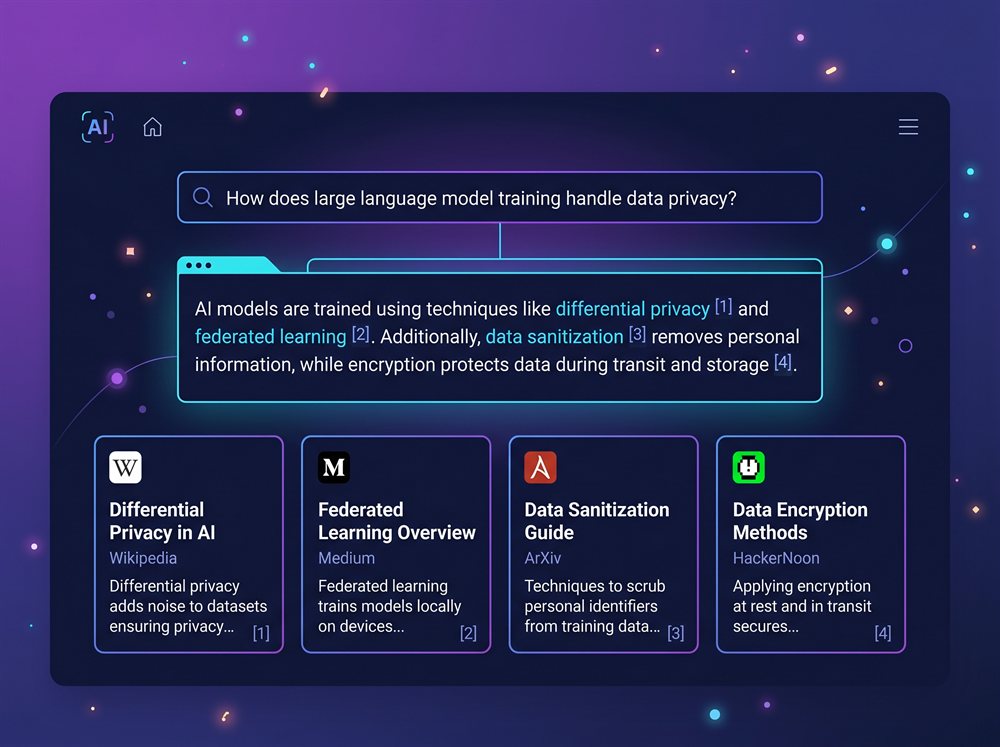
Where Perplexity is weak: it is not a science tool. If you ask it a question that requires reading 20 papers and synthesising a meta-analysis, it will search the web and return a blog-post-shaped answer, not a peer-reviewed-paper-shaped answer. For that you need the next two.
Pick Perplexity if you need a current, cited answer to any general question and trust matters more than depth. Skip it if your question is specifically about scientific evidence — the next two tools are better.
Consensus: the science of everything
Consensus does one thing the other AI tools cannot: it searches the peer-reviewed scientific literature and tells you what the evidence says. Type a yes/no question like "does creatine improve cognitive performance" or "is intermittent fasting effective for weight loss" and Consensus returns a meta-answer with a count of studies supporting each position, the sample sizes, and a confidence score. The Premium tier ($9/month) unlocks the full-text of papers, study-level detail, and a custom mode that filters by study type, sample size, and year.
The use case is narrower than Perplexity, but the answers are more authoritative. If you need to know "is X scientifically supported", Consensus will give you a defensible yes/no/maybe with citations to actual papers — not blog posts or marketing copy. This is why it's the default tool for health journalists, medical writers, and researchers doing literature reviews on tight deadlines. The other under-appreciated strength is the consistency of the answer format: you always get the same yes/no/maybe/unknown structure, so it's easy to compare across questions.
Where Consensus is weak: it only searches peer-reviewed papers. If the question is about something not yet studied (a new model, a new company, a new product), Consensus will return "not enough evidence" — even if there is plenty of useful information on blogs, X, or the company's docs. For that you need Perplexity. The other soft spot is that Consensus is optimised for natural-science questions; if you're in the humanities or social sciences, the paper coverage is thinner.
Pick Consensus if you need a defensible, peer-reviewed-backed answer to a science question. Skip it if the topic hasn't been studied yet, or if you need to synthesise non-paper sources.
Elicit: the academic research assistant
Elicit is the most academic of the three. It is built for researchers, grad students, and anyone doing a serious literature review. You give Elicit a research question and it returns a table of relevant papers with the key findings extracted — sample size, methodology, outcome, significance. The Plus tier ($12/month) unlocks unlimited paper uploads, custom extraction templates, and the ability to ask Elicit to read a paper and answer specific questions about it.
The strength is depth. Elicit is the only one of the three that can actually read a 30-page paper and answer "what was the sample size of the treatment group" or "did the authors find a statistically significant effect". It can also build a citation graph — given a seed paper, find the most-cited follow-ups. For a researcher writing a literature review, Elicit replaces 3-4 days of skimming PDFs with an afternoon of structured extraction. The other under-appreciated strength is the audit trail: every claim Elicit extracts from a paper is linked back to the exact page and sentence, so you can verify and cite correctly.
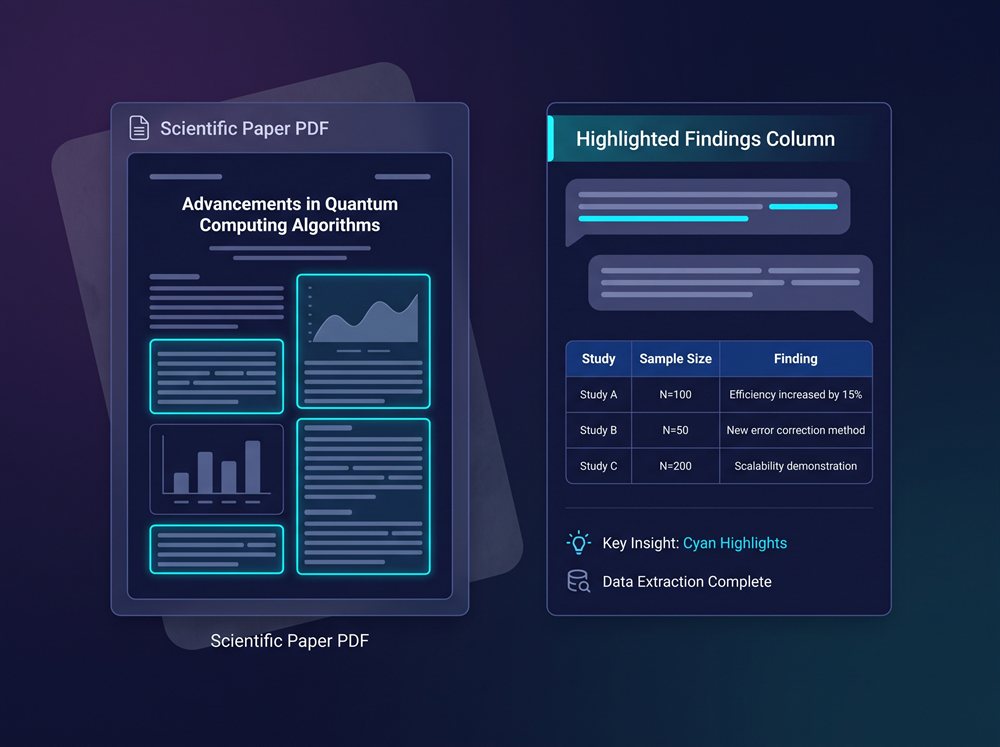
Where Elicit is weak: it is optimised for natural-science and biomedical research. If you ask it about a history question, a marketing question, or a question about a recent product launch, Elicit will not have good answers because its index is academic papers, not the web. The other soft spot is the learning curve — Elicit assumes you know what extraction columns you want, and the interface rewards a researcher mindset over a casual one.
Pick Elicit if you are doing a real literature review and need to extract structured data from many papers. Skip it if you need a quick answer to a current question — Perplexity is faster.
Comparison at a glance
| Perplexity | Consensus | Elicit | |
|---|---|---|---|
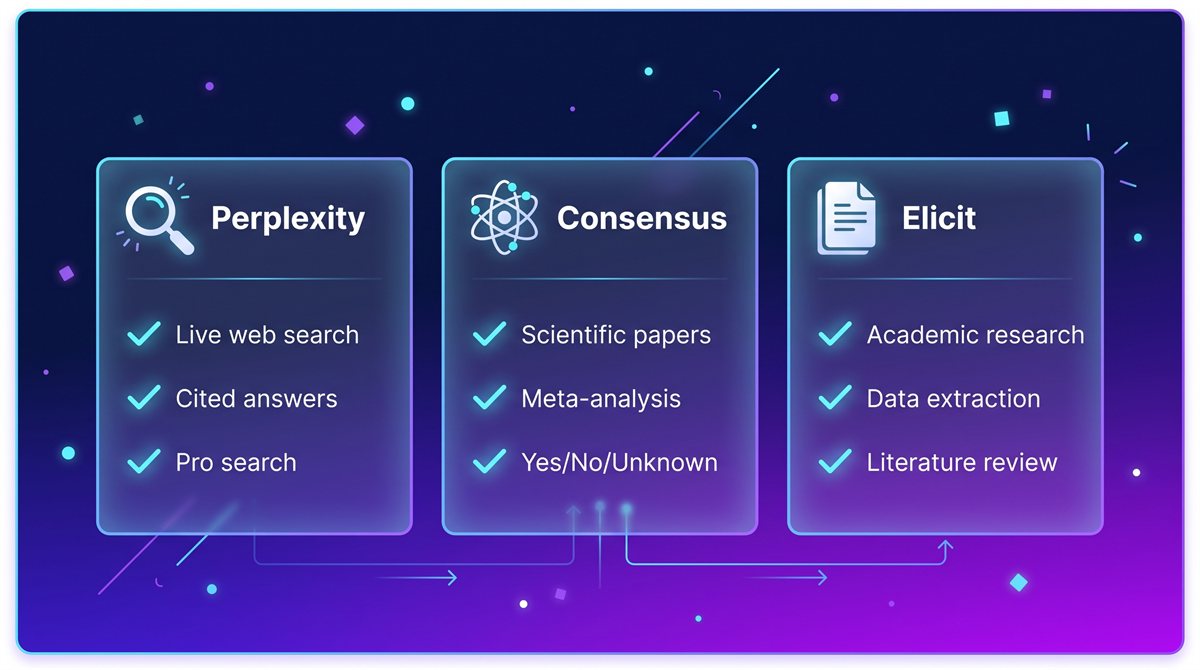
| Source | Live web | Peer-reviewed papers | Peer-reviewed papers (deep) |
| Best for | Current questions, any topic | Yes/no science questions | Literature reviews, structured extraction |
| Answer format | Written + numbered citations | Yes/No/Unknown count | Structured table of findings |
| Citations | Every claim, live URLs | Every study, paper-level | Every extraction, page-level |
| Free tier | Yes, generous | Yes, limited | Yes, limited |
| Paid | Pro $20/mo | Premium $9/mo | Plus $12/mo |
| Limitation | Not a science tool | Only peer-reviewed sources | Slowest, most academic |
Verdict by use case
If you need a quick, current, cited answer to any general question: Perplexity. The default starting point for journalists, analysts, and anyone who needs to be right and to be quick.
If you need to know what the scientific evidence says about a yes/no question: Consensus. The right tool when the question is "is X effective / safe / correlated with Y" and the answer needs to be defensible against peer review.
If you are doing a real literature review and need to extract structured findings from many papers: Elicit. The only one of the three that will replace 3-4 days of skimming PDFs with an afternoon of structured extraction.
For most research workflows, you end up using all three. Start with Perplexity to scope the question, move to Consensus to validate with peer-reviewed evidence, and use Elicit when you need to extract structured data from the specific papers that Consensus surfaces. The three compose well — they each do one job and they do not fight each other.
What to try first
If you've never used an AI research tool, start with the free tier of Perplexity. Ask it three questions you already know the answer to, and see if its citations check out. Once you trust it, upgrade to Pro for the GPT-5.6-class models. From there, add Consensus the first time you have a yes/no science question, and Elicit the first time you need to read 10+ papers in a sitting. The free tiers of each are good enough to evaluate; the paid tiers pay for themselves in saved hours.
Bottom line
Perplexity is the default for any current question, Consensus is the right tool for science yes/no questions, and Elicit is the right tool for serious literature reviews. None of them is a substitute for the others. The question is which one matches the question you actually have right now — and once you have all three in your workflow, you stop reaching for a single tool and start reaching for the right one.
See the full profiles for all three — and 59 other AI agents — in our directory.