 AI Agents Hub
Autonomous AI Coding Agents in 2026: Devin vs Manus vs Replit Agent
Three AI products claim to do autonomous software engineering in 2026. Devin is the benchmarked leader for production teams, Manus is the general-purpose agent, and Replit Agent is the in-IDE full-stack builder. Here's how to pick.
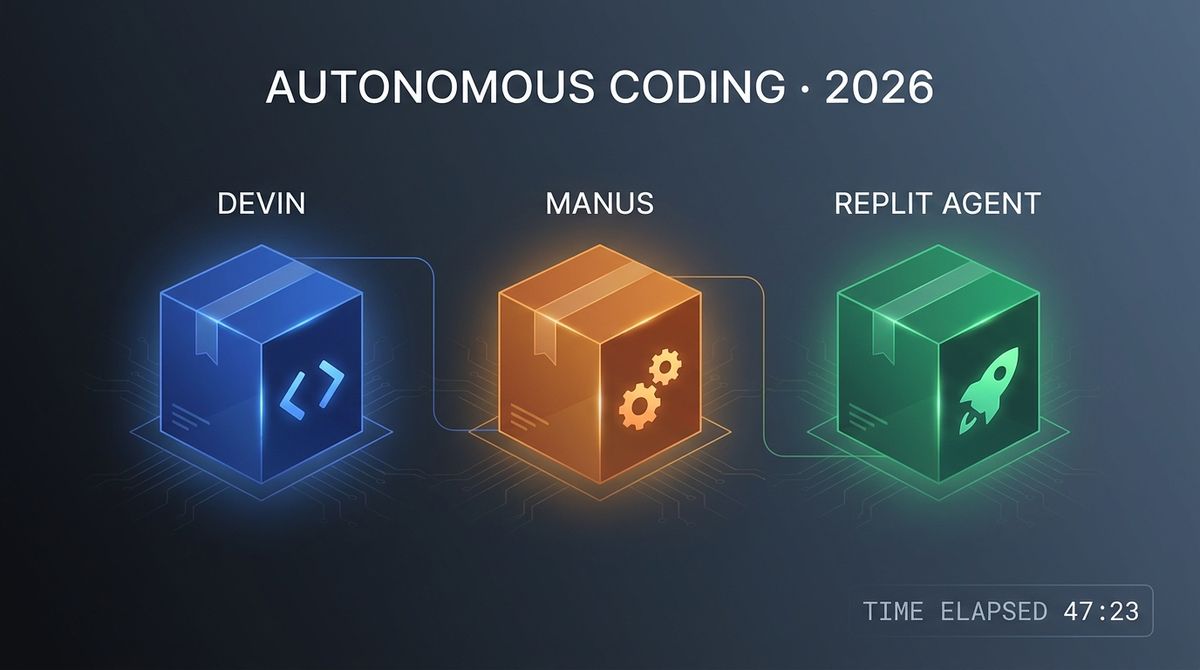
Three AI products claim to do "autonomous software engineering" in 2026. Devin from Cognition is the first major product to market and the most benchmarked. Manus is the general-purpose AI agent that handles coding as one of many tasks. Replit Agent is the in-IDE autonomous agent that builds and deploys full-stack apps in a browser sandbox. Same goal (an AI that builds software on its own), three very different products.
This post is the deeper look at the "fully autonomous" tier of AI coding — the agents that go beyond tab autocomplete and chat-based editing to actually run for minutes or hours without supervision, producing complete features or applications. We compare the three head-to-head using the profiles in our 62-agent directory.
What "autonomous" means in 2026
The AI coding agent landscape splits cleanly into three tiers. Tier 1 is completion (tab autocomplete — Cursor, Copilot). Tier 2 is agentic editing (multi-file edits in a session — Claude Code, Cline). Tier 3 is fully autonomous (the agent runs unattended, makes decisions, and ships a complete feature — the category this post covers).
The three products in this post are the leading examples of Tier 3. Each one opens a long-running session, plans the work, executes the steps, tests the result, and reports back when done. The user is not in the loop on every step — they describe a goal and return later to a working result.
Devin: the benchmarked leader
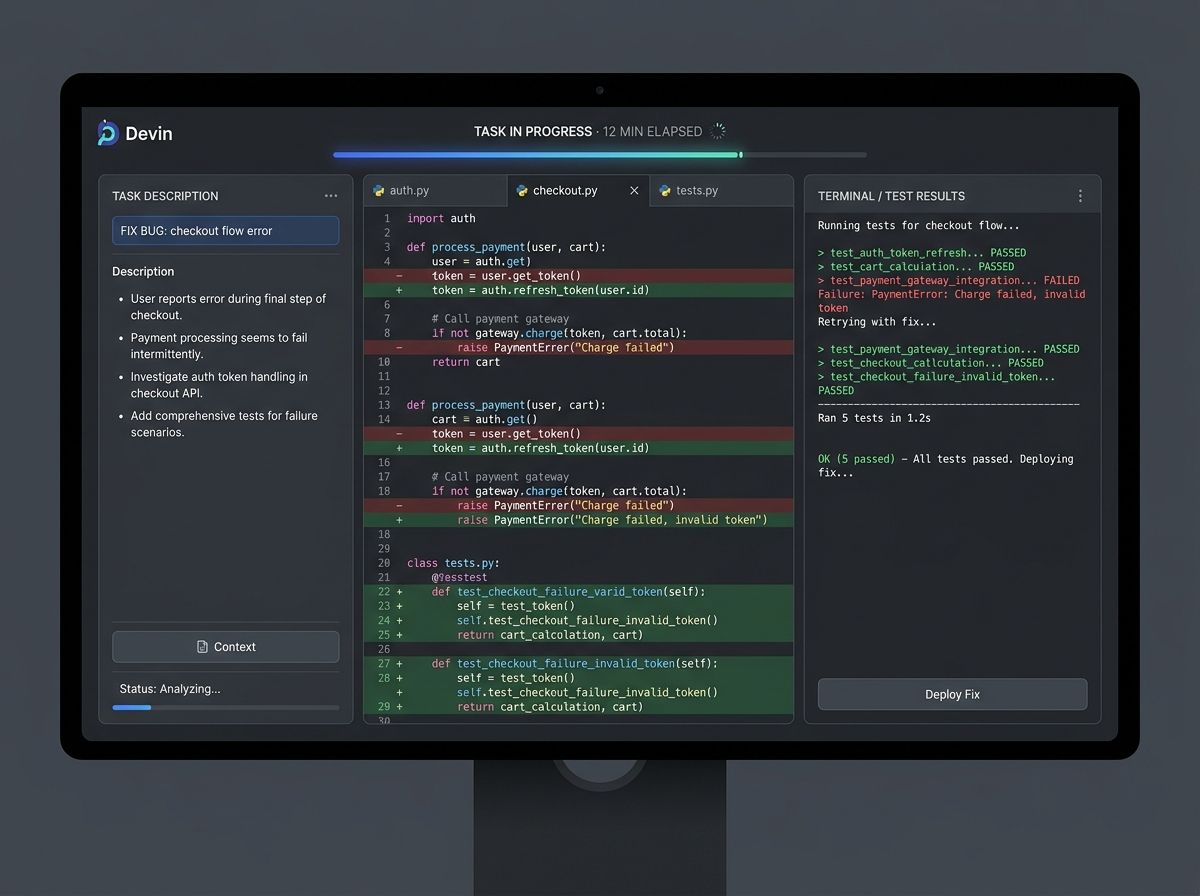
Devin is the first product to market in the autonomous category, launched by Cognition Labs in early 2024. The pitch is "an AI software engineer" — you give Devin a Slack-style task ("fix the bug in the checkout flow", "add a new API endpoint for user preferences"), and Devin spins up an isolated environment, plans the work, writes the code, tests it, and reports back with a PR ready to merge.
The standout feature is the SWE-bench performance. Devin was the first AI to score above 13% on the SWE-bench Verified benchmark (a set of real GitHub issues from popular open-source repos) in 2024. By 2026, the score has improved to ~25-30%, which is still below an experienced human developer but well above the previous generation. The benchmark is a useful proxy for "how well does this agent do on real, well-specified tasks in real codebases."
The product is not cheap. Devin is $500/month for the Team plan (with usage limits) and custom pricing for enterprise. The price reflects the compute cost — running a fully autonomous agent for hours is genuinely expensive. For a startup or team that can afford the price and has a real pipeline of "fix this bug / add this feature" tasks, the ROI can be positive. For an individual developer, the price is prohibitive.
Where Devin is weak: it is expensive, and the quality still depends heavily on the task clarity. Well-specified tasks ("fix the auth bug in /api/login") get high success rates. Vague tasks ("make the app better") waste time. The other soft spot is real-time collaboration — Devin is asynchronous, you do not sit next to it while it works. If you want a real-time pair-programming experience, the Tier 2 tools are better.
Pick Devin if you have a real pipeline of well-specified coding tasks, a budget that can absorb $500/month, and a team that can review the work asynchronously. Skip it if the tasks are vague, the budget is constrained, or you need real-time collaboration.
Manus: the general-purpose agent
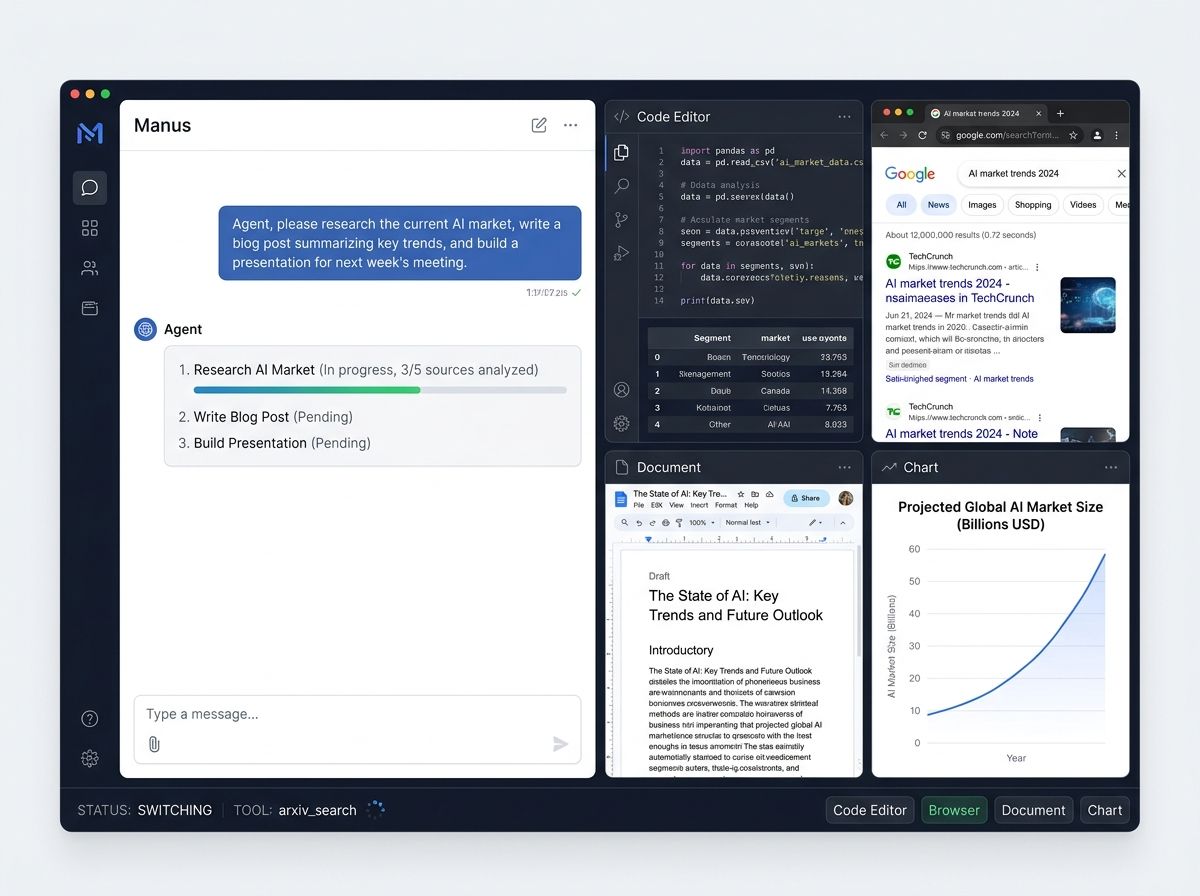
Manus is the most general-purpose of the three. Where Devin is focused on coding, Manus handles a wide range of tasks — coding, research, data analysis, web browsing, document creation. The product is positioned as a "general AI agent" rather than a "coding agent" specifically, and the autonomous coding is one of its many capabilities.
The pitch is breadth. If you want an AI that can write code, then switch to researching a market, then build a presentation, all in one continuous session, Manus is the right tool. The user experience is a chat interface where you describe a task and watch the agent work through it across multiple steps and tools.
Manus has been the most rapidly improving product in this category. The GAIA benchmark (which tests general agent capabilities) was the first major benchmark where Manus reached a competitive score with closed-source alternatives. By 2026, the agent's coding capability has reached parity with Tier 2 tools on many tasks.
Where Manus is weak: for pure coding tasks that need deep context and many hours of work, Devin still wins on the specific coding benchmarks. Manus is the better generalist, but if your only use case is coding, you are paying for capability you do not need. The other soft spot is the multi-tool approach — the agent does many things, so it is not as deeply optimized for any one of them as a focused tool is.
Pick Manus if you have a mix of tasks (coding, research, data analysis) and want one agent that handles all of them in continuous sessions. Skip it if your only use case is coding — Devin or Replit Agent are more focused and (in the case of Replit) much cheaper.
Replit Agent: the in-IDE full-stack builder
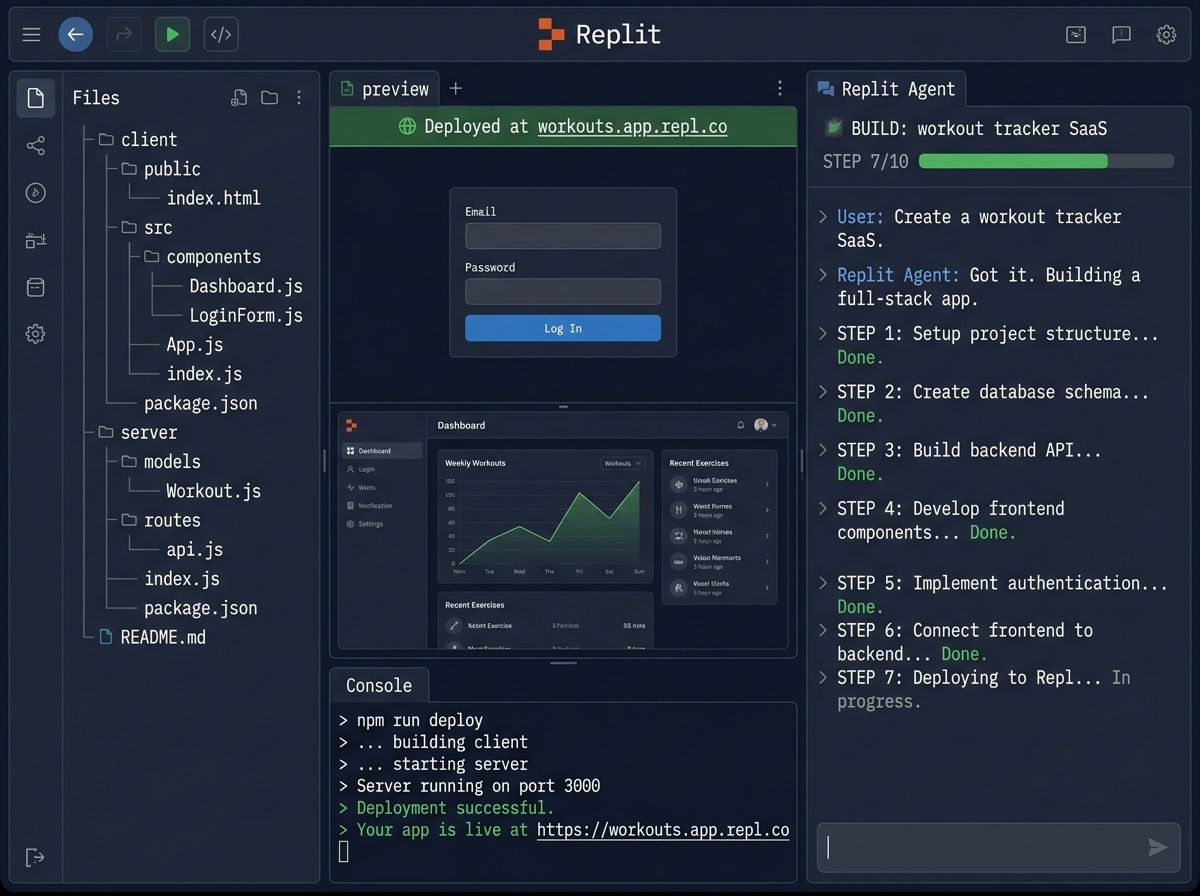
Replit Agent is the most accessible of the three. It lives inside the Replit browser IDE, where you describe a full-stack application in plain English ("build a SaaS for tracking personal workouts with user auth, a PostgreSQL database, and a Stripe subscription"), and the agent builds the entire thing in a Replit sandbox — code, database schema, deployment, and a working URL — without leaving the browser.
The pitch is "from idea to deployed app in one session." You are not in the loop on every step, but you are not separated from the work either — you watch the agent build, you can interrupt and redirect, and the final result is a deployed app on a real URL that you can share. The pricing is accessible: $25/month for the Replit Core plan (with agent usage included).
Replit Agent is the right tool for non-developers or developers who want to skip the "set up the environment, configure the database, deploy to Vercel" friction. The 2026 version handles complex multi-feature applications reliably — the success rate on a 10-feature app build is around 70-80% on the first try, with the rest requiring a single round of refinement.
Where Replit Agent is weak: it lives inside the Replit sandbox, so you cannot use it to work on your existing local codebase. If you have a real production app that needs an autonomous agent to add a feature, Replit Agent is the wrong tool — Devin or Claude Code are the right ones. The other soft spot is the framework choices — the agent defaults to specific frameworks (Replit's database, Replit's auth), and you do not get as much control over the stack as you would with a local agent.
Pick Replit Agent if you want to build a new app from scratch and get a deployed URL at the end of the session. The $25/month is accessible and the workflow is the smoothest. Skip it if you need to work on an existing local codebase, or you need fine-grained control over the framework choices.
Comparison at a glance
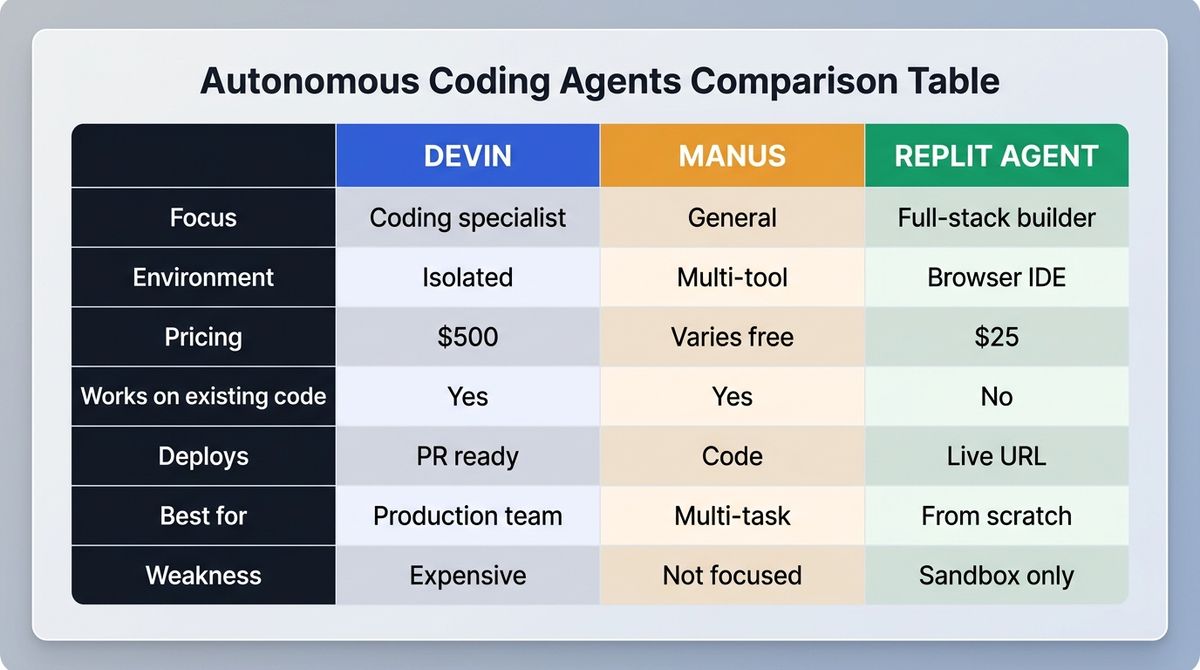
| Devin | Manus | Replit Agent | |
|---|---|---|---|
| Focus | Coding specialist | General-purpose | Full-stack app builder |
| Environment | Isolated sandbox | Multi-tool workspace | Replit browser IDE |
| Pricing | $500/mo (Team) | Varies (free tier available) | $25/mo (Core) |
| Works on existing code | Yes (GitHub integration) | Yes | No (Replit sandbox only) |
| Deploys to production | PR ready to merge | Code, no deploy | Live URL in Replit |
| Best for | Production team with budget | Multi-task workflows | New app from scratch |
| Weakness | Expensive, task clarity matters | Not as focused on coding | Sandbox only, less framework control |
Verdict by use case
If you are a production team with a real backlog: Devin. The benchmarks, the GitHub integration, and the PR-ready output are purpose-built for engineering teams with budgets. $500/month is reasonable for a team that can keep it busy.
If you have a mix of coding and non-coding tasks: Manus. The general-purpose agent handles a session that crosses coding, research, and document creation in one continuous flow. The free tier is enough to evaluate.
If you want to build a new app from scratch: Replit Agent. $25/month, browser-only, and you get a deployed URL at the end. The smoothest on-ramp to "I have a working app" of the three.
For most developers, the three are not mutually exclusive. Use Replit Agent for new app prototyping. Use Devin for the production backlog when you have the budget. Use Manus for the multi-tool workflows that mix coding with research.
What to try first
If you've never used an autonomous agent, start with Replit Agent — the lowest friction, the lowest price, and the most immediate payoff. Build a small app, see what the agent gets right and where it needs your help. From there, try Manus's free tier for a multi-tool workflow. Add Devin when you have a real backlog and a team that can absorb the $500/month cost.
Bottom line
Devin, Manus, and Replit Agent cover three different positions in the autonomous coding market. Devin is the benchmarked leader for production teams. Manus is the generalist for multi-task workflows. Replit Agent is the accessible app builder for new projects. The three are not substitutes for each other — they answer different questions. The one to pick depends on whether your bottleneck is backlog throughput (Devin), breadth of task (Manus), or speed to a deployed app (Replit).
See the full profiles — and 59 other AI agents — in our directory.