 AI Agents Hub
AI Video Generation in 2026: Runway vs Sora vs Pika
Three AI video platforms have separated from the pack in 2026: Runway is the film industry standard, Sora set the new physics realism bar, and Pika is the creator-friendly speed platform. Here's how to pick.
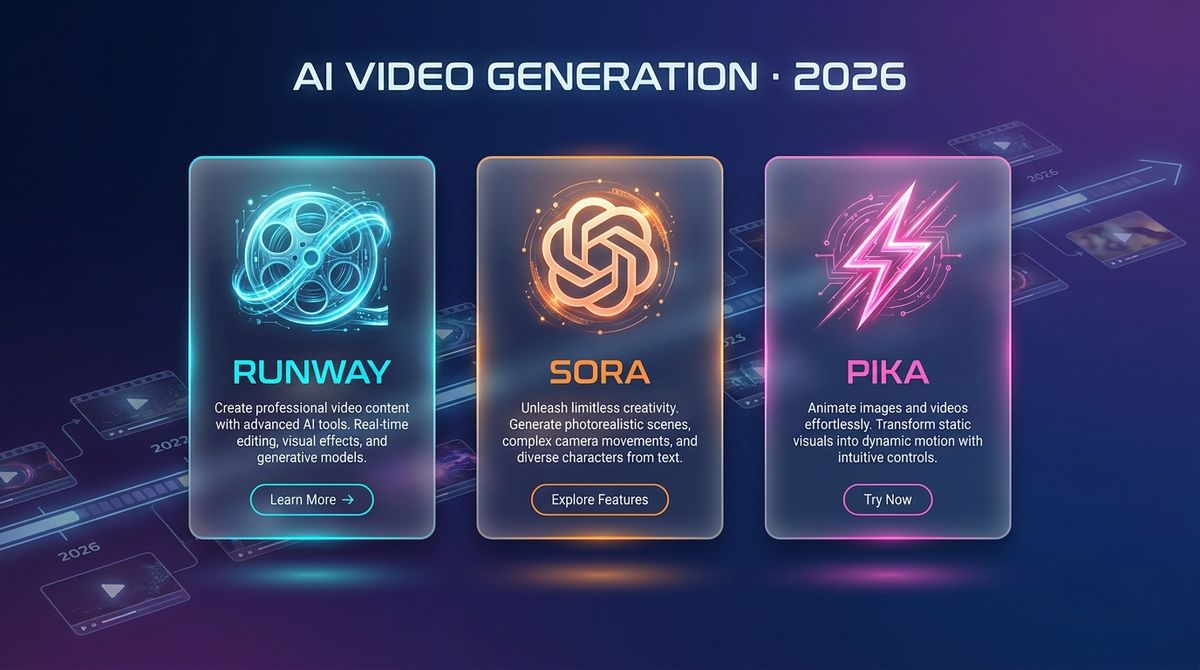
AI video generation moved from research demo to production product in 2025-2026, and three platforms have separated from the pack. Runway is the tool the film and advertising industry adopted first — the most mature, with the strongest editing and camera control features. Sora is OpenAI's text-to-video model that set the new quality bar for physical realism and long-form coherence. Pika is the creator-friendly platform that prioritizes speed, iteration, and ease of use over maximum fidelity. Same goal (AI-generated video), three very different answers.
How AI video generation works in 2026
Every text-to-video model shares the same core pattern: a transformer (or diffusion) model trained on millions of video clips learns to predict the next frame given text and previous frames. The differences between tools are in three areas: data scale (how many video clips the model trained on), architecture (transformer vs diffusion vs hybrid), and product features (UI, editing tools, post-processing).
The 2026 generation of models — Sora 2, Runway Gen-4, and the latest Pika 2.0 — all produce 5-30 second clips at 1080p+ resolution with reasonable physical coherence. The differences are in physics accuracy, camera control, character consistency, and how much post-processing the platform offers.
Runway: the film and advertising standard
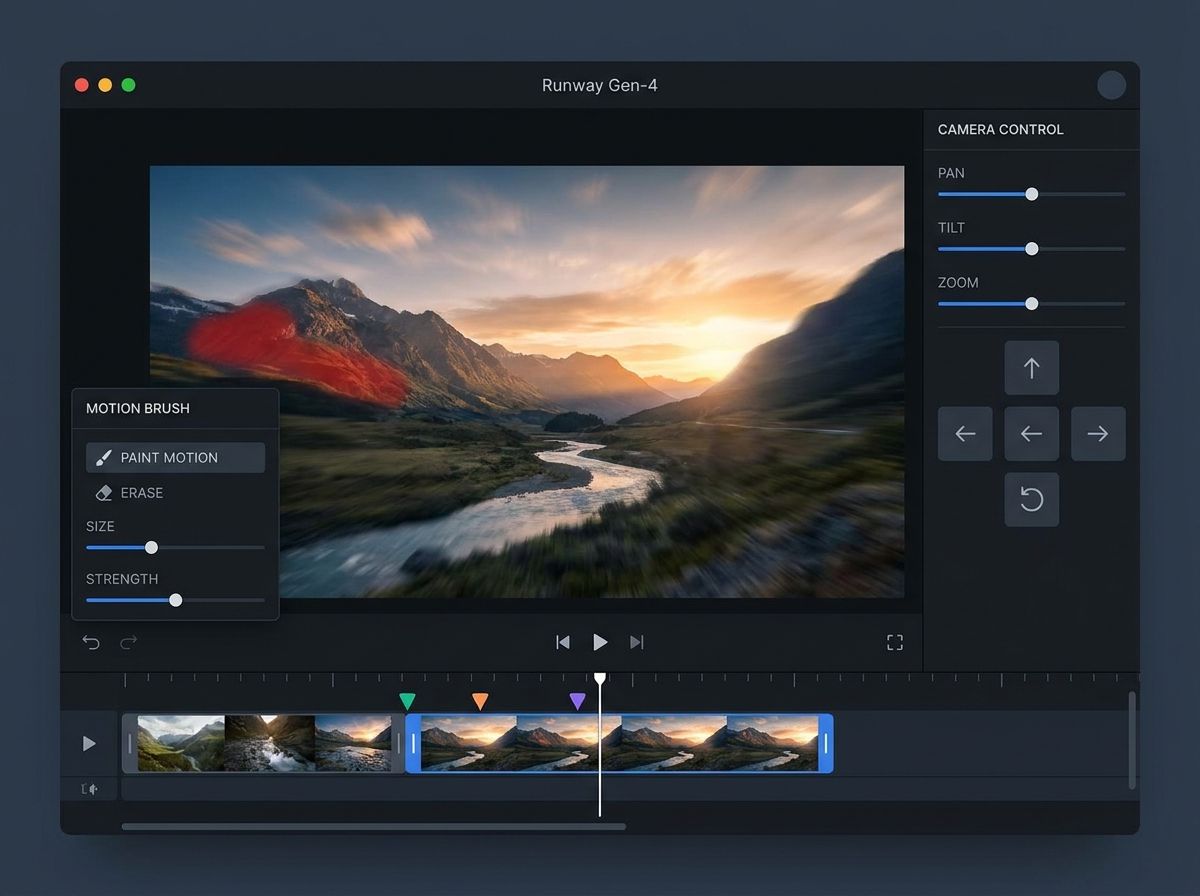
Runway is the most mature of the three. Founded in 2018, the company has been working on video models since before "AI video" was a category. The current generation, Gen-4, produces 5-10 second clips at 1080p+ resolution with strong camera control features — you can specify pan, tilt, zoom, and movement direction in the prompt, and the model respects them with high fidelity.
The standout feature is the editing suite. Runway is not just a generation tool — it is a full video post-production platform. The Multi Motion Brush lets you paint motion onto specific regions of a still image. The Camera Control panel gives you cinematic moves that would require a Steadicam in real life. The Act-One feature transfers facial expressions from a reference video onto a generated character. For a working film editor or advertising creative, this is the platform that earns the daily rate.
The pricing reflects the professional positioning. Runway's Standard plan is $15/month for 625 credits, the Pro plan is $35/month for 2,250 credits, and the Unlimited plan is $95/month. A 10-second 1080p clip costs ~50-100 credits. For occasional use, the Standard plan is enough to evaluate. For production use, Pro or Unlimited is required.
Where Runway is weak: it is the slowest of the three. Generating a 10-second clip takes 60-90 seconds on Standard, longer for higher resolution. The other soft spot is the learning curve — the editing features are powerful, but casual users find the interface dense. If you want a one-click text-to-video experience, Pika is friendlier.
Pick Runway if you are a creative professional (filmmaker, advertising creative, motion designer) who needs the strongest camera control and the most mature editing suite. Skip it if you are a casual user who wants quick clips for social — Pika or Sora are faster.
Sora: OpenAI's physical realism flagship
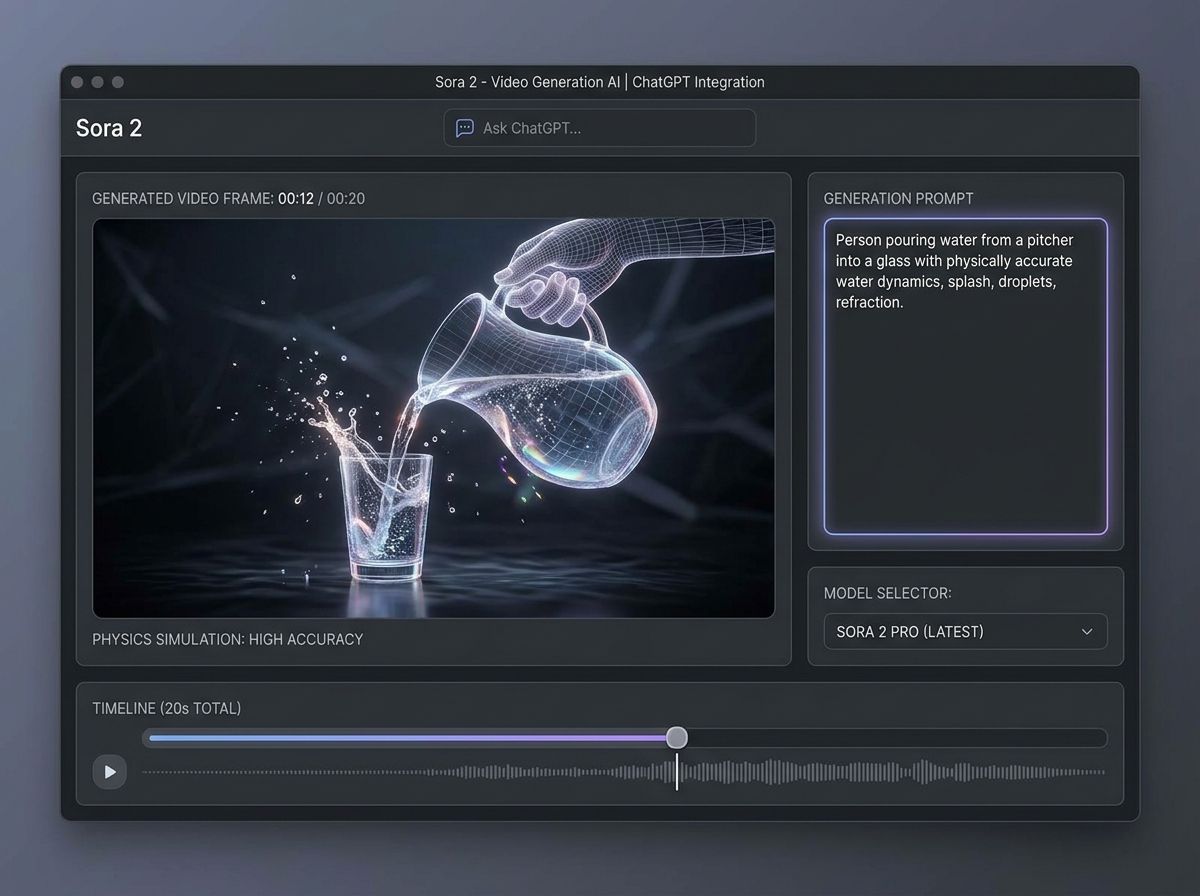
Sora is OpenAI's text-to-video model, and it set the new quality bar when the second generation launched. The standout feature is physical coherence — the model understands physics, gravity, momentum, and object permanence at a level that other models struggle to match. A person throwing a ball, water pouring into a glass, a dog running through water — the dynamics are visually correct in ways that prior models were not.
The other under-appreciated feature is duration. Sora 2 can produce 20-second clips in a single generation, longer than Runway's 5-10 seconds and Pika's 5 seconds. For storyboarding or concept videos, this length matters — you can show a continuous scene without cutting, which is the natural unit of video.
Sora is available through ChatGPT Plus ($20/month) and ChatGPT Pro ($200/month). Plus gives limited generations; Pro gives the unlimited Sora 2 access. The Pro tier is the right answer for serious video work; the Plus tier is enough to evaluate the quality. There is no standalone API as of 2026 — Sora lives inside the ChatGPT product.
Where Sora is weak: it is the most restrictive of the three. There is no API, no third-party integration, no fine-grained camera control (it is text-in, video-out only). The other soft spot is creative control — you can describe what you want, but you cannot paint motion onto specific regions, and you cannot chain clips together for longer sequences. For creative work that needs that control, Runway wins.
Pick Sora if physical realism is the primary requirement — cinematic shots, physics-based scenes, storyboards where coherence matters. Pair it with ChatGPT for prompt refinement. Skip it if you need API access, fine-grained camera control, or longer sequences built from chained clips.
Pika: the creator-friendly speed platform
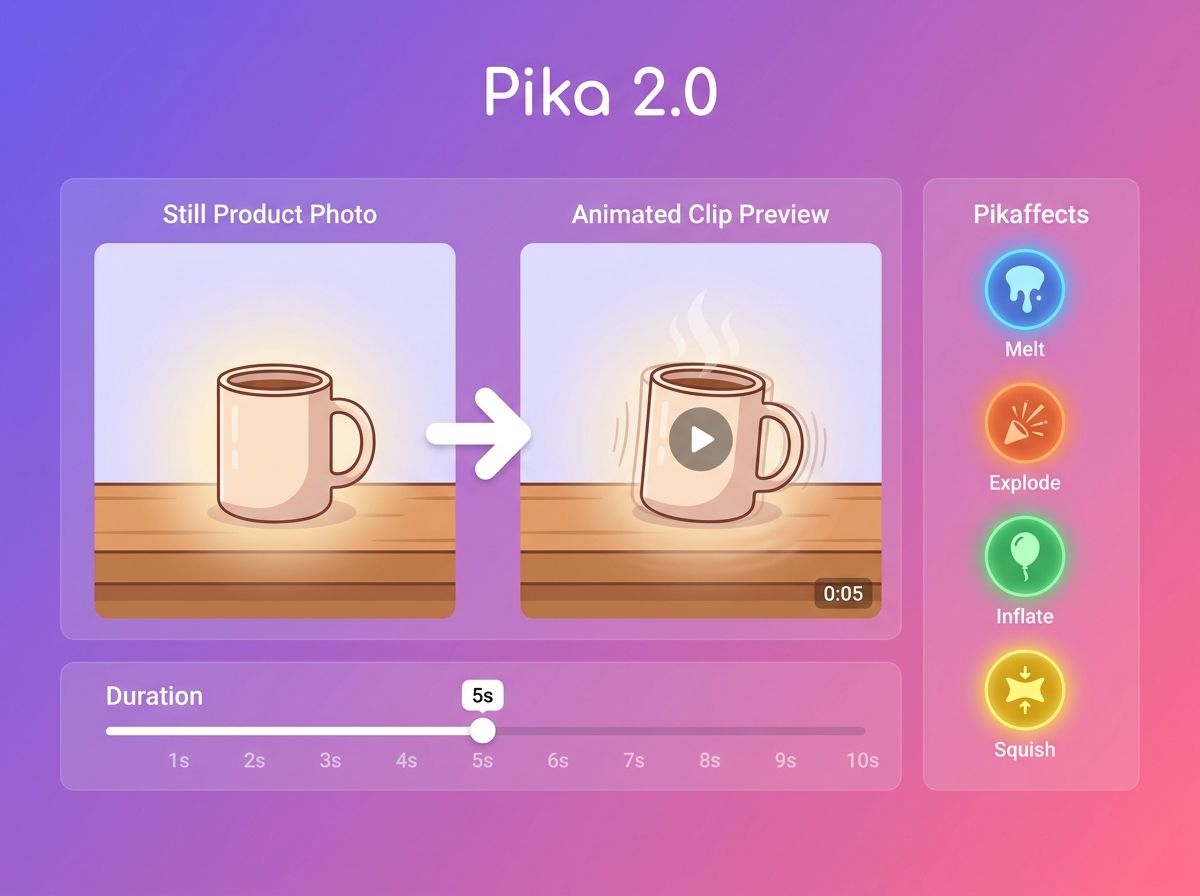
Pika is the platform that prioritizes speed and iteration over maximum fidelity. The current generation, Pika 2.0, produces 5-second clips in under 30 seconds — the fastest generation time of the three. The interface is built for creators who want to try many prompts quickly, see what works, and iterate in real time.
The standout feature is the "Pikaffects" — a library of one-click effects (melt, explode, inflate, squish) that transform any input image or video with a single button. For TikTok, Instagram Reels, and other short-form social content, this is the right tool. The other under-appreciated feature is the image-to-video flow — upload a still image, get a 5-second animated clip in 30 seconds. The use case is "I have a product photo, I need a video for Instagram" and the answer is Pika.
Pika's pricing is the most accessible. Free tier gives 250 credits (enough to evaluate). Standard is $10/month for 700 credits, Pro is $35/month for 2,000 credits, and Fancy is $95/month for 6,000 credits. For most creators, Standard is enough to produce several videos per week.
Where Pika is weak: the clip length is limited to 5 seconds, and the physical realism lags behind Sora. For a 30-second cinematic sequence or a physically accurate scene, you will not get the same quality. The other soft spot is the editing suite — Pika has fewer post-processing features than Runway, which matters if you need fine-grained control.
Pick Pika if you are a creator producing short-form social content (TikTok, Reels, YouTube Shorts) and want the fastest iteration cycle. Skip it if you need cinematic quality, long-form coherence, or fine-grained editing control — Sora or Runway are stronger.
Comparison at a glance
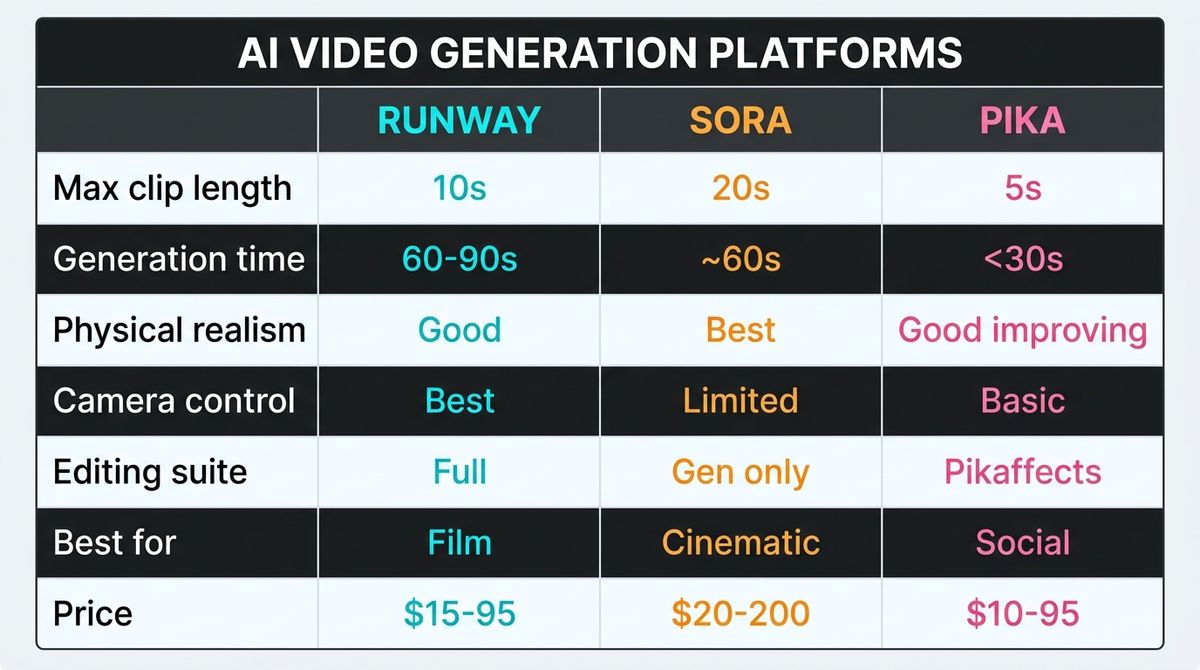
| Runway | Sora | Pika | |
|---|---|---|---|
| Max clip length | 10s | 20s | 5s |
| Generation time | 60-90s | ~60s | <30s |
| Physical realism | Good | Best in class | Good (improving) |
| Camera control | Best in class | Limited (text only) | Basic |
| Editing suite | Full post-production | Generation only | Pikaffects + basic |
| API access | Yes | No (ChatGPT only) | Yes |
| Best for | Film / advertising | Cinematic realism | Social content |
| Price | $15-95/mo | $20-200/mo (ChatGPT) | $10-95/mo |
Verdict by use case
If you are a filmmaker or advertising creative: Runway. The camera control, the editing suite, and the post-production features are purpose-built for professional video work. Budget $35-95/month for production use.
If physical realism is the primary requirement: Sora. The physics coherence, the 20-second clip length, and the quality bar set a new standard. Subscribe to ChatGPT Pro ($200/month) for unlimited Sora 2 access.
If you are a creator producing short-form social content: Pika. The fast iteration, the image-to-video flow, and the Pikaffects are built for the TikTok/Reels use case. $10-35/month is enough.
For most creative teams, the three are complementary. Use Sora for cinematic realism in concept videos. Use Runway for the final cut with camera control. Use Pika for the social content derived from both. The three compose well — they don't fight each other.
What to try first
If you've never used an AI video tool, start with Pika's free tier — upload a photo, generate a 5-second clip, see what works. Once you've felt the category, move to Sora via ChatGPT Plus to see the quality bar. Add Runway when you need camera control or post-production features. The three are not mutually exclusive — the sequence above gets you to "useful output" fastest.
Bottom line
Runway, Sora, and Pika have found distinct positions in the 2026 AI video market. Runway is the professional film and advertising standard. Sora is OpenAI's physics-realism flagship. Pika is the creator-friendly speed platform. Pick the one that matches your use case — or use all three, since the workflow that gets the most out of AI video in 2026 is to use Sora for the best quality shots, Runway for the cinematic edits, and Pika for the social derivatives.
See the full profiles — and 59 other AI agents — in our directory.