 AI Agents Hub
AI Customer Service in 2026: Sierra vs Decagon
Two AI customer service platforms dominate the enterprise market. Sierra is the brand-voice platform that prioritizes customer experience. Decagon is the resolution-efficiency platform built for high-volume support operations. Here's how to pick.
Two AI customer service platforms have become the default for serious enterprise deployments in 2026. Sierra is the conversational AI platform that prioritizes brand voice and customer experience — the choice of consumer brands that need to maintain a specific tone across every interaction. Decagon is the AI customer service platform that prioritizes resolution speed and operational efficiency — the default for high-volume support operations. Same goal (AI that handles customer service), two very different design philosophies.
How AI customer service works in 2026
Both Sierra and Decagon deploy AI agents that handle customer conversations across chat, email, and (increasingly) voice. The agents are trained on your knowledge base, your policies, and your historical support interactions. The differences are in the agent architecture, the brand voice fidelity, the resolution workflows, and the operational features.
The 2026 versions of both platforms handle 60-80% of routine customer inquiries without human intervention, and the rest get routed to human agents with full context. The question is which platform gives you the right balance of customer experience, operational efficiency, and integration with your existing support stack.
Sierra: the brand voice platform
Sierra is the platform that prioritized customer experience from the start. The pitch is "an AI agent that sounds like your brand, knows your customers, and handles the conversation the way your best human agent would." Sierra was founded by Bret Taylor (ex-Salesforce co-CEO, ex-Facebook CTO) and Clay Bavor (ex-Google VP), and the product reflects their belief that customer experience is a competitive moat.
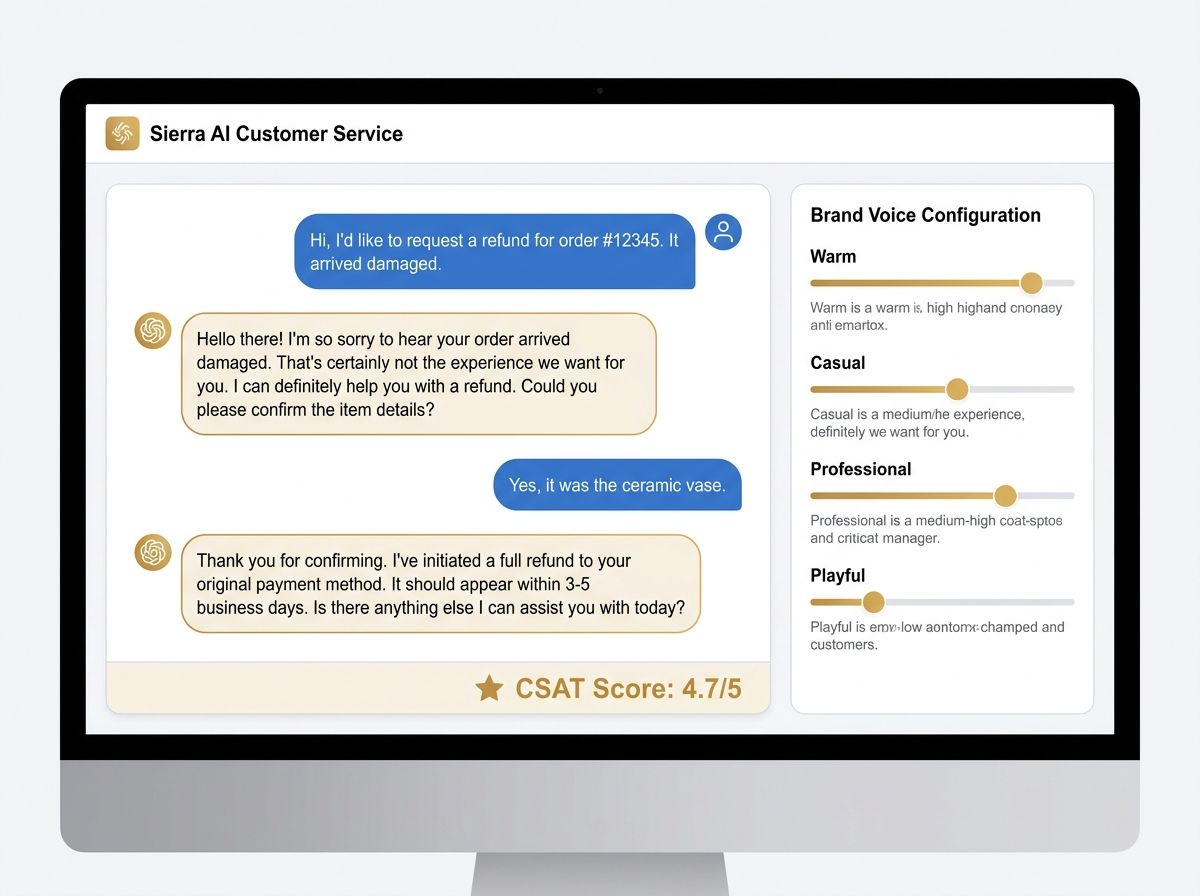
The standout feature is the brand voice fidelity. Sierra's agents can be configured to match a specific tone — warm and casual, professional and direct, playful and informal, or any custom blend. The model is trained on your existing customer conversations and learns the specific language patterns your best agents use. The result is an AI agent that customers cannot easily distinguish from your best human agents.
The other under-appreciated feature is the conversational depth. Sierra's agents handle multi-turn conversations naturally — they remember context across the conversation, they ask clarifying questions when needed, and they handle complex scenarios (refund requests, account changes, troubleshooting) without breaking the interaction. For a consumer brand where customer experience is a competitive differentiator, this is the right platform.
Where Sierra is weak: the operational efficiency is not the primary focus. The agents are optimized for experience, not for maximum deflection. If your primary KPI is "how many tickets can we resolve without a human," Decagon will deliver higher numbers. The other soft spot is the integration story — Sierra works well with the major CRMs and helpdesks, but custom integrations require more work than Decagon's out-of-the-box connectors.
Pick Sierra if you are a consumer brand where customer experience is a competitive moat, and you need an AI agent that maintains your specific brand voice across every interaction. Skip it if your primary KPI is operational efficiency and you need maximum ticket deflection — Decagon is more focused on that.
Decagon: the resolution efficiency platform
Decagon is the platform that prioritized operational efficiency. The pitch is "an AI agent that resolves customer issues fast, integrates with your existing stack, and gives you the operational metrics you need to scale support without scaling headcount." The platform is built for high-volume support operations where the primary goal is to resolve tickets quickly and accurately.
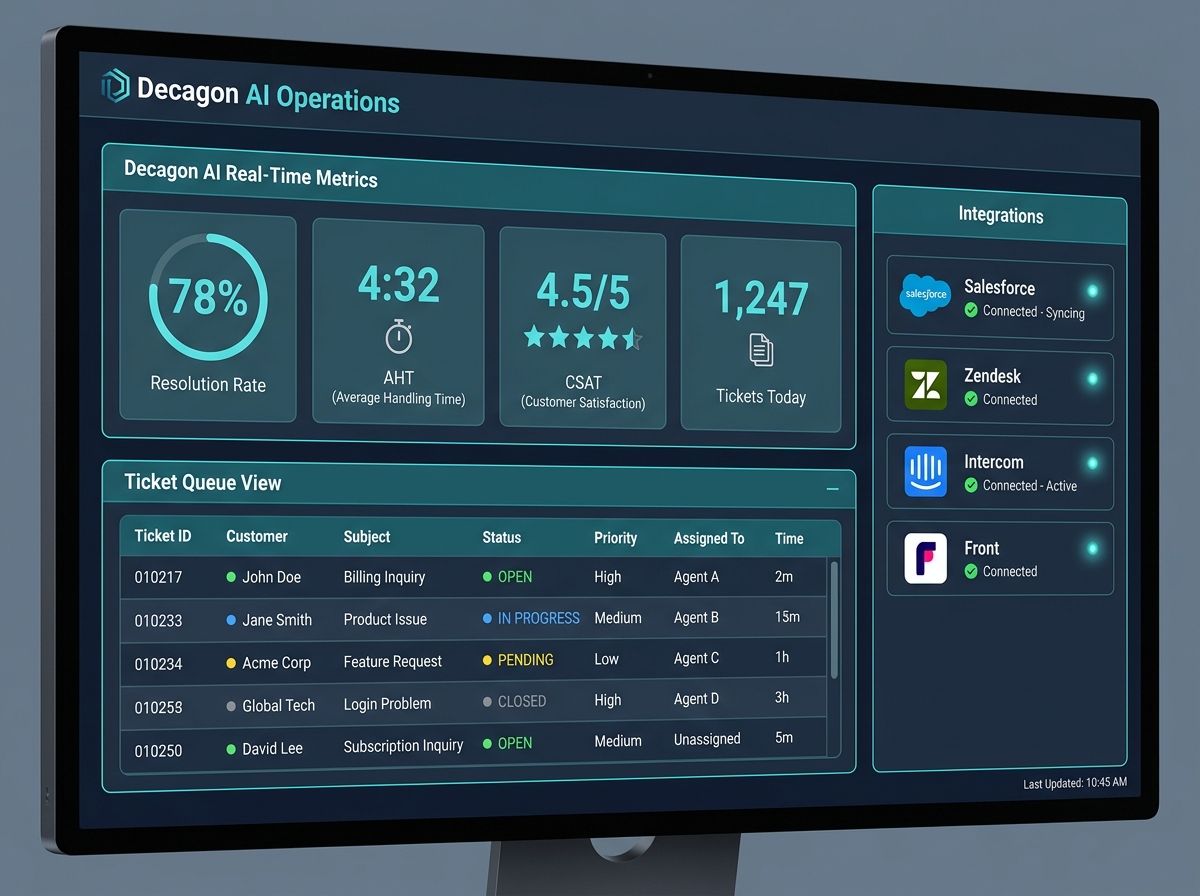
The standout feature is the resolution speed. Decagon's agents are optimized for first-contact resolution — they answer the question, take the action (refund, account change, order modification), and close the ticket in a single conversation. The integration with the major CRMs and helpdesks (Salesforce, Zendesk, Intercom, Front) is deep, which means the agent has access to the customer data and the action tools it needs to resolve without escalating to a human.
The other under-appreciated feature is the operational analytics. Decagon gives you real-time visibility into resolution rates, average handling time, customer satisfaction, and the specific topics that are generating tickets. The analytics help you identify patterns — which products generate the most tickets, which customer segments need the most help, which support topics are growing — and use that data to improve the product, the knowledge base, and the agent's training.
Where Decagon is weak: the brand voice fidelity is not the primary focus. The agents are professional and accurate, but they do not have the same level of tone customization as Sierra. For a consumer brand that cares deeply about every word the agent says, Sierra is the better choice. The other soft spot is the conversational depth — Decagon's agents handle routine tickets well, but the very complex or unusual customer situations are more likely to be escalated to a human than with Sierra.
Pick Decagon if you run a high-volume support operation and your primary KPI is resolution speed and ticket deflection. Skip it if you are a consumer brand where customer experience is the differentiator — Sierra is better for that.
Comparison at a glance
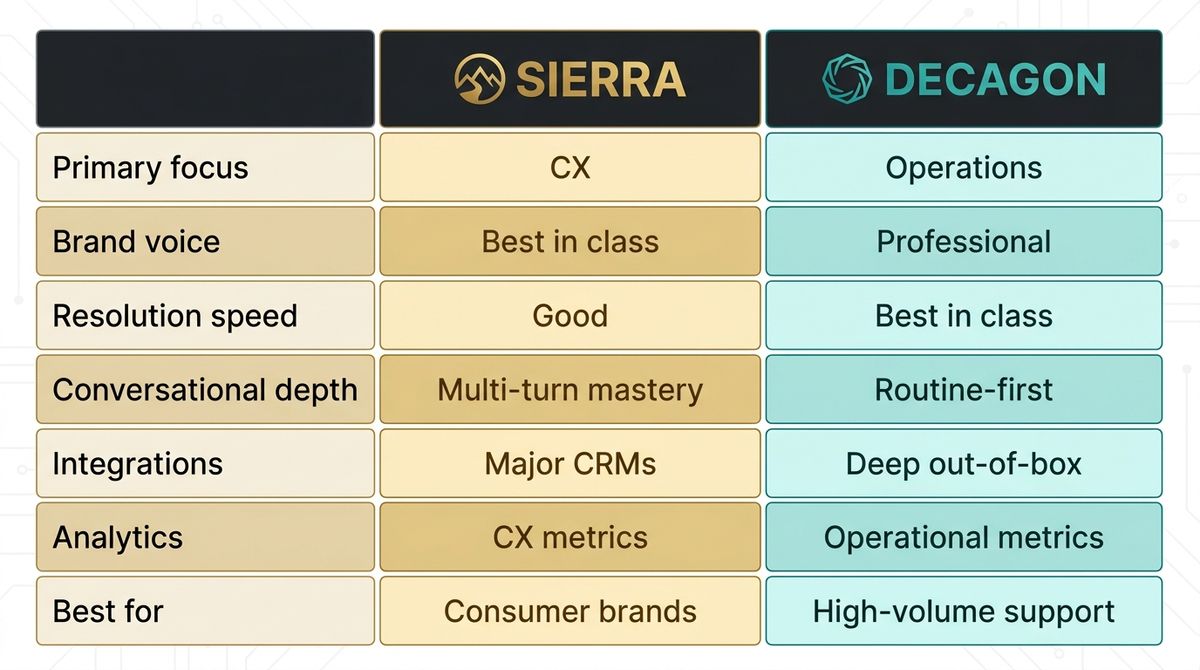
| Sierra | Decagon | |
|---|---|---|
| Primary focus | Customer experience | Operational efficiency |
| Brand voice | Best in class (custom tone) | Professional (less customization) |
| Resolution speed | Good | Best in class |
| Conversational depth | Multi-turn mastery | Routine-first, escalates complex |
| Integrations | Major CRMs (custom for others) | Deep out-of-box (Salesforce, Zendesk, Intercom) |
| Analytics | CX metrics (CSAT, sentiment) | Operational metrics (resolution, AHT, topics) |
| Best for | Consumer brands (CX moat) | High-volume support operations |
Verdict by use case
If you are a consumer brand where customer experience is a competitive moat: Sierra. The brand voice fidelity, the conversational depth, and the focus on customer experience are the right combination for brands that compete on CX.
If you run a high-volume support operation: Decagon. The resolution speed, the deep integrations, and the operational analytics are the right combination for support operations that need to scale without scaling headcount.
If you are a B2B SaaS company with technical support: Decagon. The deep CRM integrations and the operational metrics help you manage a technical support operation that needs to integrate with your product, billing, and customer data.
If you are a luxury or premium consumer brand: Sierra. The brand voice customization and the conversational depth are critical for premium brands where the customer experience is the product.
For most large companies, the two are not mutually exclusive. Use Sierra for the high-touch customer interactions where brand voice matters most. Use Decagon for the high-volume routine tickets where resolution speed matters most. The right architecture for most companies is a layered system that routes the right ticket to the right platform.
What to try first
If you are evaluating AI customer service for the first time, start by clarifying your primary KPI. If it is customer experience and brand voice, start with Sierra. If it is resolution speed and operational efficiency, start with Decagon. Both platforms offer pilot programs where you can deploy a limited-scope agent and measure the results against your specific KPIs.
Bottom line
Sierra and Decagon cover two different positions in the AI customer service market. Sierra is the customer experience platform that prioritizes brand voice. Decagon is the operational efficiency platform that prioritizes resolution speed. The one to pick depends on whether your primary KPI is customer experience (Sierra) or operational efficiency (Decagon) — and for most large companies, the right answer is to use both for different ticket types.
See the full profiles — and 59 other AI agents — in our directory.