 AI Agents Hub
AI Chat Models in 2026: Claude vs ChatGPT vs DeepSeek
Three AI chat products dominate 2026. Claude leads on reasoning and safety. ChatGPT leads on ecosystem and multimodal. DeepSeek leads on cost and open weights. Here's how to pick the right one.
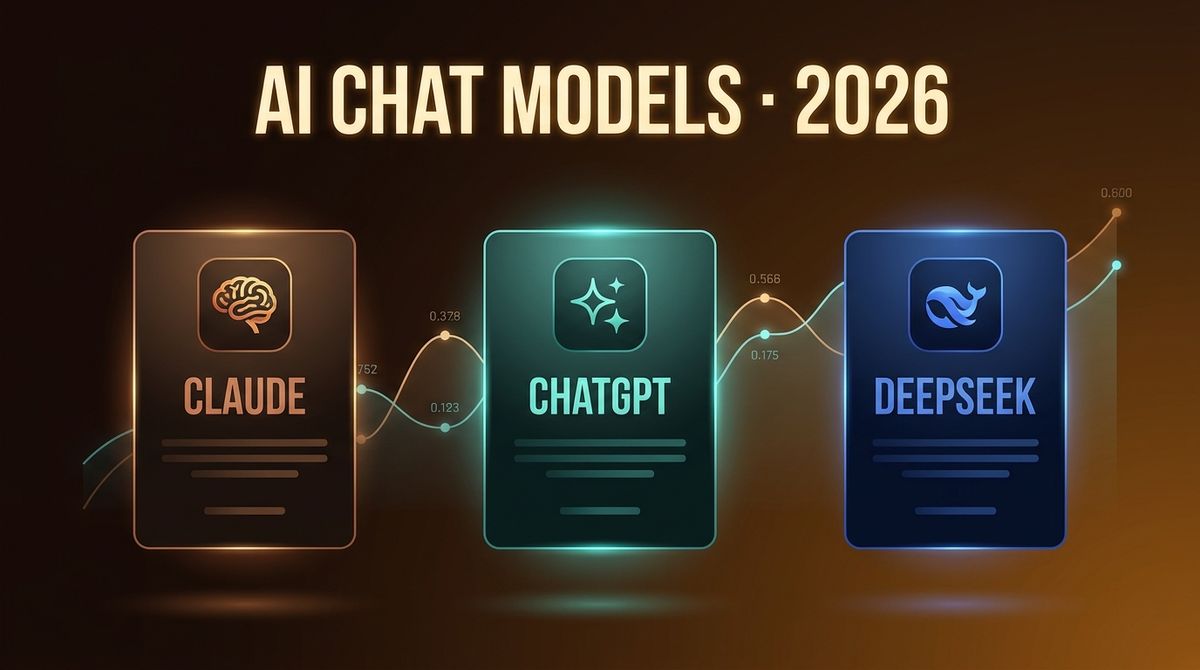
Three AI chat products dominate the consumer and prosumer market in 2026. Claude (Anthropic) is the model that set the bar for long-context reasoning and safety-conscious deployment. ChatGPT (OpenAI) is the product that brought AI chat to the mainstream — still the most-used AI assistant globally. DeepSeek is the Chinese open-weight model that has closed the quality gap with US frontier labs at a fraction of the inference cost. Same goal (frontier-quality AI chat), three very different bets on model architecture, pricing, and ecosystem.
If you are picking an AI assistant for personal use, for your team, or as the backbone of a product, the three have converged in capability but diverged sharply in cost, openness, and integration. This post compares them head-to-head using the profiles in our 62-agent directory.
The state of frontier AI chat in 2026
By 2026, the gap between the top three consumer-facing AI assistants has narrowed significantly. Claude Opus 4.5, ChatGPT-5.6, and DeepSeek-V4 all score within 5-10% of each other on most reasoning benchmarks, all support 100K+ token context windows, and all produce production-quality output for the common cases (writing, coding, analysis, brainstorming). The differences are in the cost, the openness, the safety stance, and the integration story — not the raw capability.
This is a different market than 2024. Two years ago, the choice was "ChatGPT or Claude" and DeepSeek was a research curiosity. Today, the three are all credible options and the choice depends on your priorities more than the model's raw strength.
Claude: the reasoning and safety leader
Claude is Anthropic's AI assistant, and the positioning in 2026 is "the most thoughtful, most carefully aligned, most reliable frontier model." The Opus 4.5 model handles long-context reasoning (200K tokens standard, 1M tokens for enterprise), nuanced instruction-following, and complex multi-step analysis with the same quality bar that made Claude a default for developers and analysts.
The standout feature is the artifact-style interaction model. Claude chat is built around the idea that the model can produce runnable artifacts (code, documents, diagrams, simulations) that you can iterate on inside the conversation. The other frontier models have added similar features, but Anthropic's interpretation is the most polished — Claude is the model that turned "AI chat" from Q&A into a workspace.
The pricing is premium. Claude Pro is $20/month (similar to ChatGPT Plus), Max is $100-200/month for higher usage. The API pricing is $15-75 per million tokens depending on the model. For a power user who needs the best reasoning quality and values the safety/alignment stance, the price is justified. For a casual user, the free tier (with rate limits) is enough to evaluate.
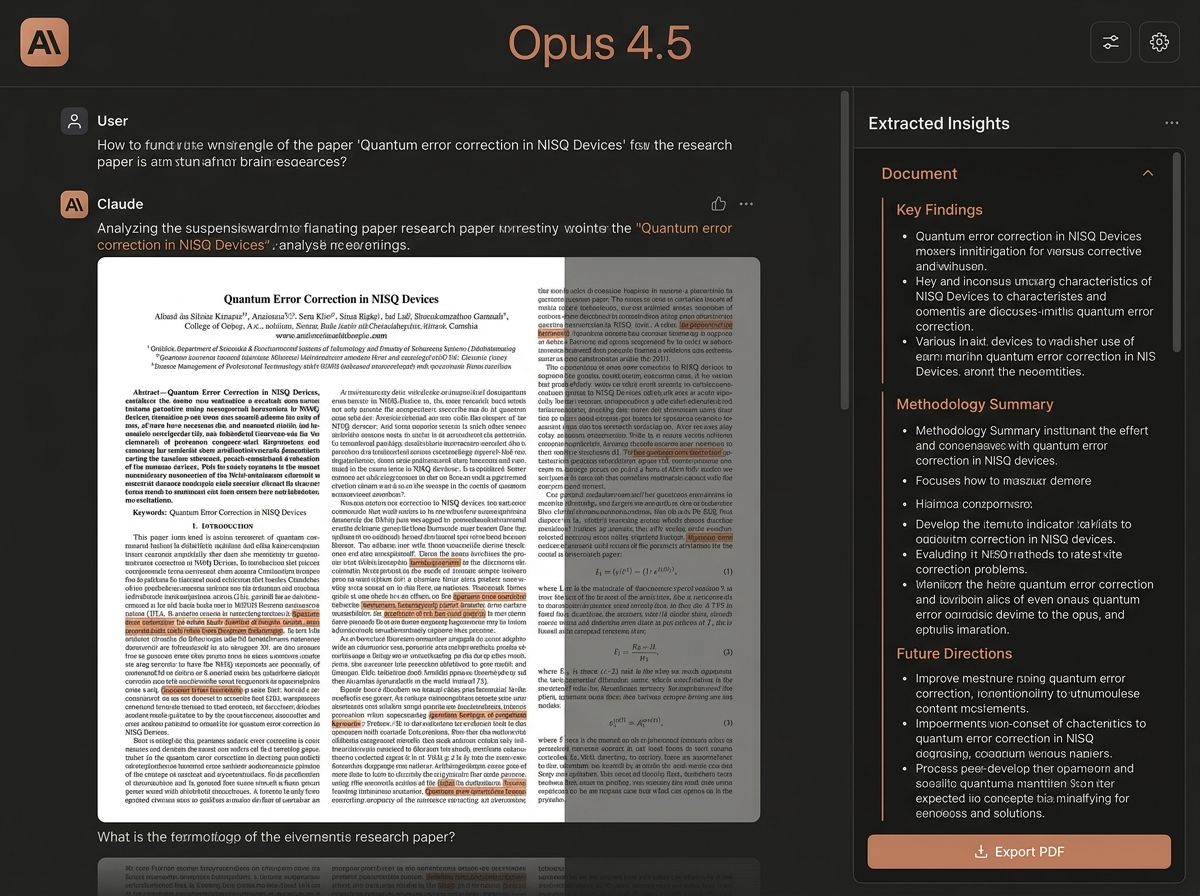
Where Claude is weak: the ecosystem is smaller than ChatGPT. There are fewer third-party plugins, fewer integrated products, and the developer tooling (while excellent for the API) does not have the same breadth as OpenAI's. The other soft spot is multimodality — Claude is strong on text and code, but image and voice generation are less mature than ChatGPT's. For a product that needs multimodal capabilities out of the box, ChatGPT is ahead.
Pick Claude if you need the best reasoning quality, you work with long documents, you value the safety/alignment stance, and the workspace-style interaction model fits how you work. Skip it if you need a deep ecosystem of plugins and integrated products, or you need strong multimodality.
ChatGPT: the ecosystem and product leader
ChatGPT is OpenAI's consumer product, and the positioning in 2026 is "the most complete AI assistant on the market." GPT-5.6 powers the chat, the multimodal inputs (text, image, voice, video), the tool integration (web browsing, code execution, DALL-E, custom GPTs), and the Operator browser agent we covered earlier. The breadth of the product is unmatched.
The standout feature is the ecosystem. ChatGPT has 1M+ custom GPTs built by the community, deep integration with the major productivity tools (Microsoft 365, Google Workspace, Zapier), and the strongest multimodal story (image understanding, image generation, voice conversation, video understanding). For a user who wants one AI product that does everything, ChatGPT is the default answer.
The pricing is competitive. ChatGPT Plus is $20/month (the same as Claude Pro), Pro is $200/month for unlimited access to the top models and the Operator agent, and the Team and Enterprise plans add collaboration features. The free tier (GPT-5 mini) is enough for casual use; the paid tiers are for power users.
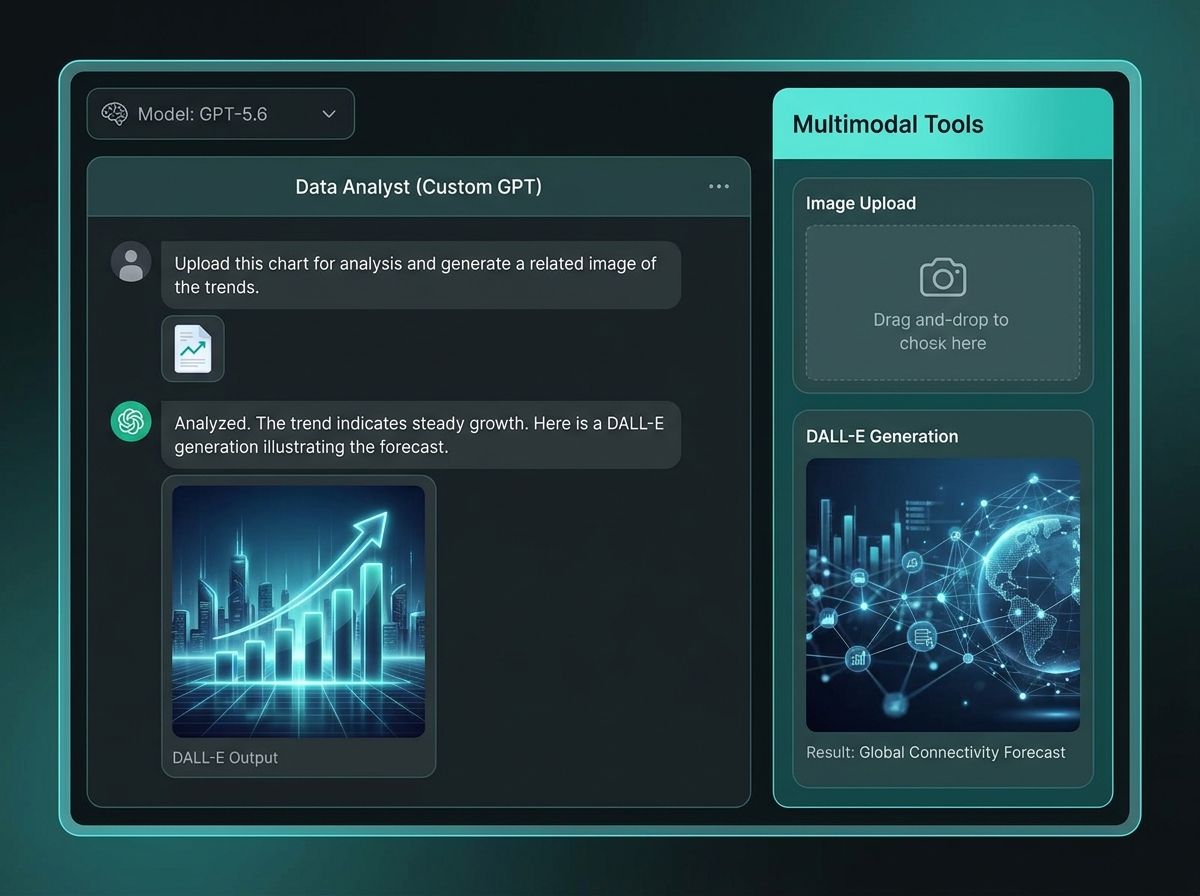
Where ChatGPT is weak: the raw reasoning quality has narrowed the gap with Claude, and on some benchmarks (long-context analysis, nuanced instruction-following) Claude is still ahead. The other soft spot is the safety stance — OpenAI's safety practices are less conservative than Anthropic's, which means ChatGPT will sometimes produce content that Claude would refuse. For a user who values refusal behavior, Claude is the safer choice.
Pick ChatGPT if you want the most complete AI assistant with the largest ecosystem, you need strong multimodal capabilities (image, voice, video), and the breadth of features (custom GPTs, web browsing, Operator) is more valuable than a single-feature edge. Skip it if you need the deepest reasoning quality, or you prefer the more conservative safety stance.
DeepSeek: the open-weight challenger
DeepSeek is the Chinese AI lab that has taken the open-weight model world by storm. The positioning in 2026 is "frontier-quality reasoning at 5-10% of the inference cost." The DeepSeek-V4 model matches GPT-5.6 and Claude Opus 4.5 on most reasoning benchmarks while being dramatically cheaper to run — which has made it the default for cost-sensitive applications and the foundation of countless open-source fine-tunes.
The standout feature is the cost-quality ratio. DeepSeek-V4 API pricing is $0.14-2.19 per million tokens, compared to $15-75 for Claude and OpenAI. For a product that needs to process millions of tokens per day, the cost difference is not incremental — it is the difference between a viable business and an unviable one. The model is also fully open-weight, which means you can self-host, fine-tune, and inspect.
The pricing for the consumer product is very accessible. DeepSeek chat is free or cheap (compared to Claude and ChatGPT Plus), the API is the cheapest among the frontier models, and the open-weight license allows self-hosting. For a developer building a product, this is the default starting point in 2026.
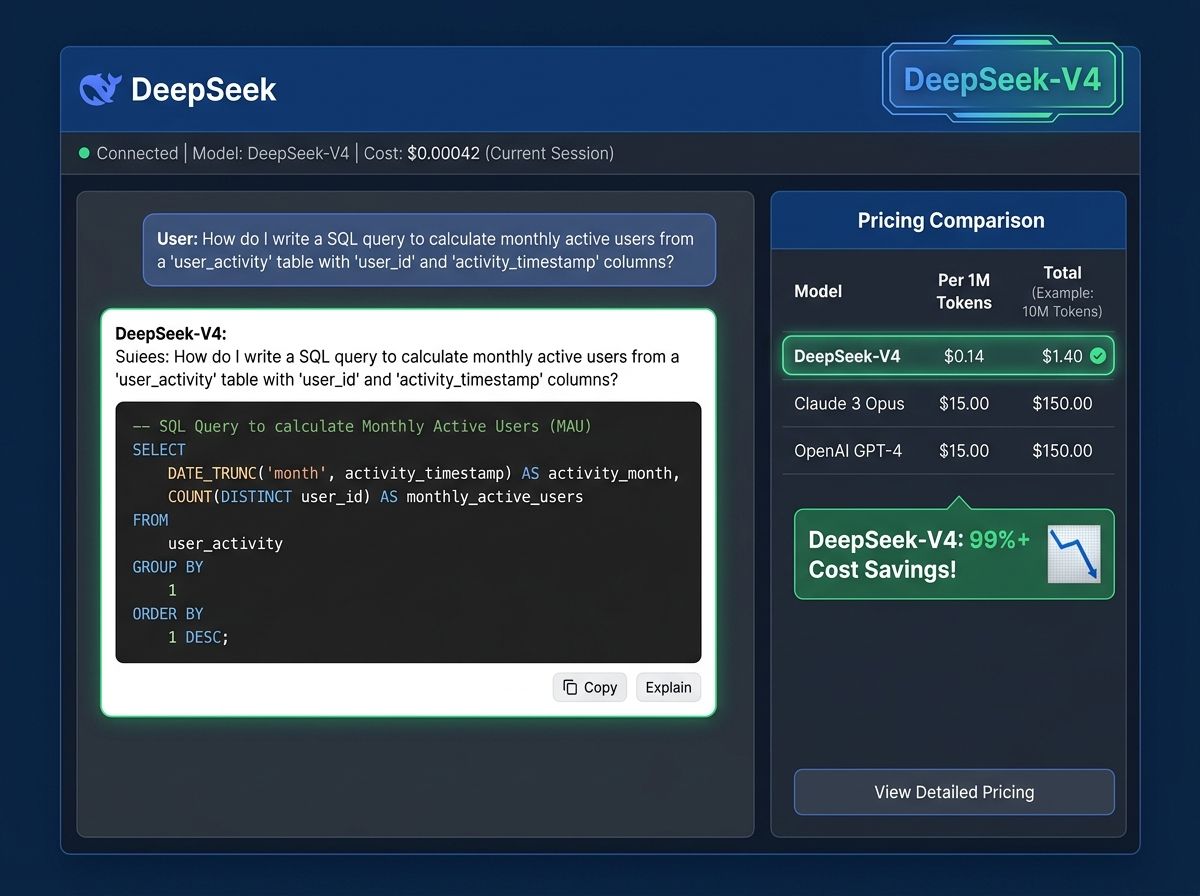
Where DeepSeek is weak: the consumer product experience is less polished than Claude or ChatGPT. The chat interface is functional but not best-in-class. The other soft spot is the ecosystem — there are fewer integrations, fewer plugins, and the multimodal story is less developed. For a product that needs the polished UX of ChatGPT or the workspace model of Claude, DeepSeek requires more assembly.
Pick DeepSeek if you are building a product that needs to process a lot of tokens (the cost difference is decisive), you want to self-host or fine-tune, or you need the open-weight model for compliance reasons. Skip it if you want a polished consumer experience or a deep ecosystem.
Comparison at a glance
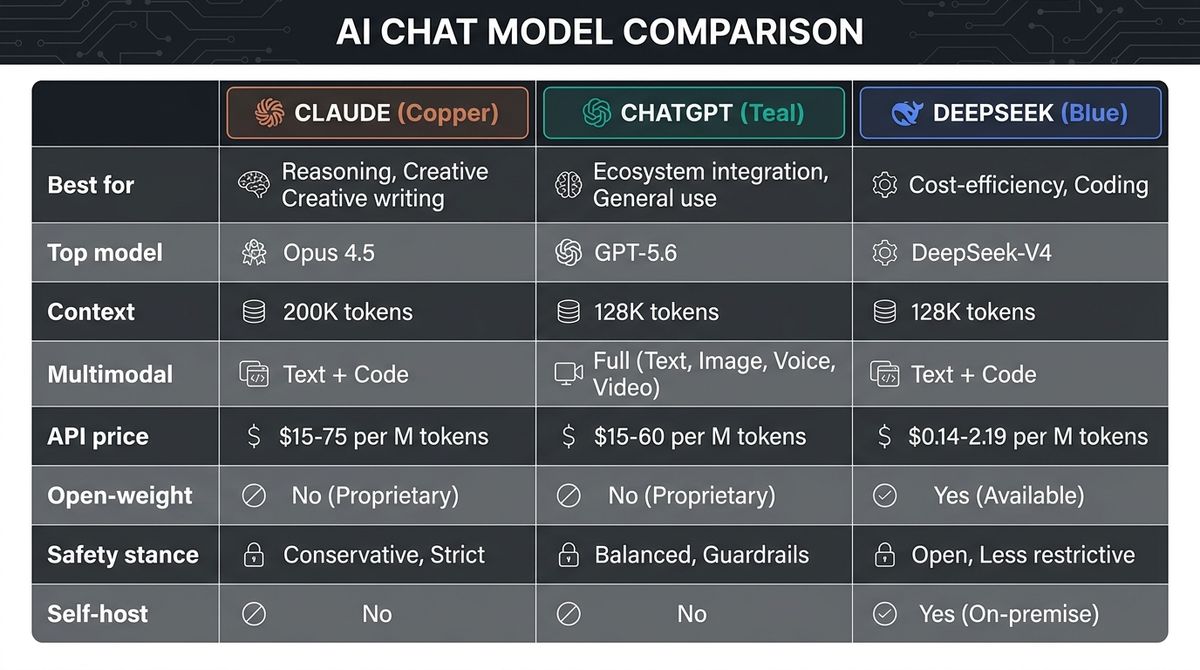
| Claude | ChatGPT | DeepSeek | |
|---|---|---|---|
| Best for | Reasoning, long-context | Ecosystem, multimodal | Cost, open-weight |
| Top model | Opus 4.5 | GPT-5.6 | DeepSeek-V4 |
| Context window | 200K (1M enterprise) | 128K (256K Pro) | 128K |
| Multimodal | Text, code, image (limited) | Text, image, voice, video | Text, code (limited) |
| Ecosystem | API, Claude Code | Largest (1M+ GPTs, plugins) | API, open-source community |
| API price (per 1M tokens) | $15-75 | $15-60 | $0.14-2.19 |
| Open-weight | No | No | Yes (Apache 2.0-like) |
| Consumer price | Pro $20, Max $100-200 | Plus $20, Pro $200 | Free or very low |
| Safety stance | Most conservative | Balanced | Open |
| Self-host | No | No | Yes |
Verdict by use case
If you need the best reasoning quality and work with long documents: Claude. The Opus 4.5 model, the artifact workspace, and the safety stance are the right combination for analysts, writers, and developers who care about quality and reliability.
If you want the most complete AI product and need multimodal capabilities: ChatGPT. The ecosystem, the multimodal story, the custom GPTs, and the Operator browser agent are the most complete package in the market.
If you are building a product that needs to process a lot of tokens: DeepSeek. The cost-quality ratio is decisive for token-heavy applications. Self-hosting is the answer for compliance-sensitive use cases.
If you are a researcher who needs the open weights: DeepSeek. The Apache 2.0-like license, the strong reasoning, and the active community make it the default starting point for fine-tuning and research.
For most power users, the three are not mutually exclusive. Use Claude for the long-form reasoning and writing tasks. Use ChatGPT for multimodal tasks, custom GPTs, and product integrations. Use DeepSeek for the API-heavy, cost-sensitive parts of your workflow. The three compose well — they don't fight each other.
What to try first
If you've never used a frontier AI chat, start with the free tier of whichever your current preference is — Claude, ChatGPT, and DeepSeek all have free or low-cost entry points. Once you've felt the category, add a second product for the use case the first does poorly. The most common combo in 2026 is ChatGPT for the ecosystem + Claude for the reasoning. Add DeepSeek when cost starts to matter or when you need open weights.
Bottom line
Claude, ChatGPT, and DeepSeek are the three credible frontier AI chat products in 2026. Claude is the reasoning and safety leader. ChatGPT is the ecosystem and product leader. DeepSeek is the cost and open-weight leader. The one to pick depends on whether your bottleneck is reasoning quality (Claude), breadth of features (ChatGPT), or cost and openness (DeepSeek) — and for most power users, the answer is to use two or all three for different parts of the workflow.
See the full profiles — and 59 other AI agents — in our directory.